Quick Time and iTunes for XPSP2 and Vista
My experience with trying to install Kodak Easy Share Software last night (for the first time since the advent of my new hard drive) and this morning has given newfound strength in one of my favorite sayings:
IF IT'S NOT BROKEN, DON'T FIX IT!
Of course, EasyShare requires Quick Time (videos on my wife's digital camera, a Kodak, are saved in .mov format). So, I made the mistake of making sure my Quick Time and iTunes are up to date. The latest versions are iTunes 7.5 and Quick Time 7.3. However, these updates are not too friendly with Windows Vista, nor are they friendly with Windows XP/Service Pack 2, which I am running. iTunes 7.5 simply gives you the old boot (iTunes has encountered a problem and needs to close). Quick Time 7.3 boots you in a different way - via the infamous "buffer overrun".
A little cruising through Apple's support forums proved that I was not alone. I found, first, a few Vista users with the similar problem, and then a few of those who said, "I get that problem too, and I have XP Service Pack Deux". Apparently Apple has yet to develop a fix or patch for it (though I can picture some fellow Catholic podcasters saying "You should have bought a Mac"). A couple of people replied with outside links to "beat the buffer overrun".
My wife gave me a better solution - use the older version. So, she gave me the link to older versions of Quick Time. You pick the one you want to revert to. Then she gave me the link to older versions of iTunes. I haven't reverted my iTunes yet. I did, however, revert my Quick Time to 7.1 (if you do this, always make sure you uninstall the newest version COMPLETELY first), and it works like a charm. I'll take care of iTunes soon. But first, I have to finish this nice videocast I'm concocting.
Oh - here are the links for those XPSP2/Vista users who need a fix:
Quick Time: http://www.oldversion.com/program.php?n=quicktime
iTunes: http://oldapps.com/itunes.htm
I'll say it again - IF IT'S NOT BROKEN, DON'T FIX IT!
Peace,
BMP

Thursday, December 6, 2007

Wednesday, December 5, 2007
FUNNY MUSIC VIDEO OF THE DAY
This one was handed to me via e-mail by Lyn, the Organ-ic Chemist. Here the organ playing is excellent. That homemade trumpet ("tromba") using heater hose and a car horn (revealed in the comments in YouTube) makes the whole thing just comical. I couldn't make out the description in YouTube, however, since I don't understand Italian. If anyone wants to translate for me, be my guest. Enjoy!
Peace,
BMP
Peace,
BMP
Tuesday, December 4, 2007
SING TO THE LORD, PARS SECUNDA
This second part of my review of Sing to the Lord takes us through The Church at Prayer.
16. In his capacity as “the chief steward of the mysteries of God in the particular Church entrusted to his care,” the diocesan bishop is particularly concerned with the promotion of the dignity of liturgical celebrations, “the beauty of the sacred place, of music, and of art.” He carries out this duty through the example of his own celebration of the Sacred Liturgy, encouraging sung participation by his own example; by his attention to the practice of liturgical music in the parishes and communities of his diocese, especially in his own cathedral church; by his promotion of the continuing musical education and formation of clergy and musicians; and by his careful attention to the musical training of future priests and deacons.
17. The bishop is assisted in this role by his staff in the diocesan Office of Worship and/or the diocesan music or liturgical commission, which provides “valuable assistance in promoting sacred music together with pastoral liturgical action in the diocese.”
Are you sure? There are some bishops who are very good in implementing good liturgy. But there are some others, well.... not so good.
19. The importance of the priest’s participation in the Liturgy, especially by singing, cannot be overemphasized. The priest sings the presidential prayers and dialogues of the Liturgy according to his capabilities, and he encourages sung participation in the Liturgy by his own example, joining in the congregational song. “If, however. . . the priest or minister does not possess a voice suitable for the proper execution of the singing, he can render without singing one or more of the more difficult parts which concern him, reciting them in a loud and distinct voice. However, this must not be done merely for the convenience of the priest or minister.”
I've worked for my share of them in my day. I even once worked for a priest who opted to SAY the Exsultet at the Easter Vigil, instead of having a cantor chant it if he REALLY couldn't.
20. Seminaries and other programs of priestly formation should train priests to sing with confidence and to chant those parts of the Mass assigned to them. Those priests who are capable should be trained in the practice of chanting the Gospel on more solemn occasions when a deacon may not be present. At the very least, all priests should be comfortable singing those parts of the Eucharistic Prayer that are assigned to them for which musical notation is provided in the Roman Missal.
I've worked with only one deacon (no priests) who ever chanted the Gospel in the Ordinary Form of the Mass. Otherwise, the only time I've ever heard the Gospel chanted is in the Extraordinary Form.
21. The priest joins with the congregation in singing the acclamations, chants, hymns, and songs of the Liturgy. However, the priest does not join in the singing of the Memorial Acclamation or the Great Amen. To the greatest extent possible, he should use a congregational worship aid during the processions and other rituals of the Liturgy and should be attentive to the cantor and psalmist as they lead the gathered assembly in song. In order to promote the corporate voice of the assembly when it sings, the priest’s own voice should not be heard above the congregation, nor should he sing the congregational response of the dialogues. While the assembly sings, the priest should step back from a microphone, or, if he is using a wireless microphone, he should turn it off.
First emphasis: The priest doesn't join in singing the Memorial or Amen??? That's a first.
Dialogue emphasis: Highly agreed! That might give me a change of heart in the first emphasis above.
Microphone emphasis: Very highly agreed! As for the wireless mic, I'm not a big fan of those to begin with, especially when you start hearing enough static to fill three basilicas and a cathedral.
23. In accord with their abilities, deacons should be prepared to sing those parts of the Liturgy that belong to them. Deacons should receive training in singing the dialogues between deacon and people, such as those at the Gospel and at the dismissal. They should also learn to sing various invitations in the rites, the Exsultet, the third form of the Act of Penitence, and the Prayer of the Faithful. If they are capable, deacons should be trained in the practice of chanting the Gospel on more solemn occasions. Programs of diaconal preparation should include major and compulsory courses in the chant and song of the Liturgy.
Agreed. I have worked with some singing deacons. Although I must admit, the last deacon I worked with, an elderly gentleman -- very nice guy, he and I got along great, but hardly any voice, let alone a singing voice.
In my next post of this series, "The Gathered Liturgical Assembly". OMG! There's that word "Gathered" again! (OY VEY!)
Peace,
BMP
16. In his capacity as “the chief steward of the mysteries of God in the particular Church entrusted to his care,” the diocesan bishop is particularly concerned with the promotion of the dignity of liturgical celebrations, “the beauty of the sacred place, of music, and of art.” He carries out this duty through the example of his own celebration of the Sacred Liturgy, encouraging sung participation by his own example; by his attention to the practice of liturgical music in the parishes and communities of his diocese, especially in his own cathedral church; by his promotion of the continuing musical education and formation of clergy and musicians; and by his careful attention to the musical training of future priests and deacons.
17. The bishop is assisted in this role by his staff in the diocesan Office of Worship and/or the diocesan music or liturgical commission, which provides “valuable assistance in promoting sacred music together with pastoral liturgical action in the diocese.”
Are you sure? There are some bishops who are very good in implementing good liturgy. But there are some others, well.... not so good.
19. The importance of the priest’s participation in the Liturgy, especially by singing, cannot be overemphasized. The priest sings the presidential prayers and dialogues of the Liturgy according to his capabilities, and he encourages sung participation in the Liturgy by his own example, joining in the congregational song. “If, however. . . the priest or minister does not possess a voice suitable for the proper execution of the singing, he can render without singing one or more of the more difficult parts which concern him, reciting them in a loud and distinct voice. However, this must not be done merely for the convenience of the priest or minister.”
I've worked for my share of them in my day. I even once worked for a priest who opted to SAY the Exsultet at the Easter Vigil, instead of having a cantor chant it if he REALLY couldn't.
20. Seminaries and other programs of priestly formation should train priests to sing with confidence and to chant those parts of the Mass assigned to them. Those priests who are capable should be trained in the practice of chanting the Gospel on more solemn occasions when a deacon may not be present. At the very least, all priests should be comfortable singing those parts of the Eucharistic Prayer that are assigned to them for which musical notation is provided in the Roman Missal.
I've worked with only one deacon (no priests) who ever chanted the Gospel in the Ordinary Form of the Mass. Otherwise, the only time I've ever heard the Gospel chanted is in the Extraordinary Form.
21. The priest joins with the congregation in singing the acclamations, chants, hymns, and songs of the Liturgy. However, the priest does not join in the singing of the Memorial Acclamation or the Great Amen. To the greatest extent possible, he should use a congregational worship aid during the processions and other rituals of the Liturgy and should be attentive to the cantor and psalmist as they lead the gathered assembly in song. In order to promote the corporate voice of the assembly when it sings, the priest’s own voice should not be heard above the congregation, nor should he sing the congregational response of the dialogues. While the assembly sings, the priest should step back from a microphone, or, if he is using a wireless microphone, he should turn it off.
First emphasis: The priest doesn't join in singing the Memorial or Amen??? That's a first.
Dialogue emphasis: Highly agreed! That might give me a change of heart in the first emphasis above.
Microphone emphasis: Very highly agreed! As for the wireless mic, I'm not a big fan of those to begin with, especially when you start hearing enough static to fill three basilicas and a cathedral.
23. In accord with their abilities, deacons should be prepared to sing those parts of the Liturgy that belong to them. Deacons should receive training in singing the dialogues between deacon and people, such as those at the Gospel and at the dismissal. They should also learn to sing various invitations in the rites, the Exsultet, the third form of the Act of Penitence, and the Prayer of the Faithful. If they are capable, deacons should be trained in the practice of chanting the Gospel on more solemn occasions. Programs of diaconal preparation should include major and compulsory courses in the chant and song of the Liturgy.
Agreed. I have worked with some singing deacons. Although I must admit, the last deacon I worked with, an elderly gentleman -- very nice guy, he and I got along great, but hardly any voice, let alone a singing voice.
In my next post of this series, "The Gathered Liturgical Assembly". OMG! There's that word "Gathered" again! (OY VEY!)
Peace,
BMP
ALLELUIA FOR ADVENT I
Written by Georgeann Kovac, played by "Posaune16" on YouTube. Far better than what's often played today (namely the Celtic Alleluia). Though he only sang the Alleluia once the first time, I'm sure it could be intoned then repeated as well. What I really liked, besides the music being quite good (had a nice Richard Proulx flavor to it, I think), was that it was only one alleluia and not three-fold, or six-fold, or whatever. Though the word "alleluia" can be repeated multiple times, the single alleluia maintains faithfulness to both the Lectionary for Mass AND the Graduale Romanum. Anyhoo, nice work, and LMAO at how HP Photosmart is credited at the end!
Peace,
BMP
PS: I subscribe to this guy's videos at YouTube!
Peace,
BMP
PS: I subscribe to this guy's videos at YouTube!
ANOTHER COOL SACRED MUSIC BLOG FOUND
Discovered by some colleagues at the Contemporary Catholic Music boards, we welcome to the CV Definitive Blogroll Sacred Music for the New Millenium, promoting the use of sacred music in Catholic liturgy. Enjoy!
Peace,
BMP
Peace,
BMP
Monday, December 3, 2007
PASTORAL MUSIC MAGAZINE ARCHIVE
NaPalM has just opened its doors to the entire archive of back issues to its periodical, Pastoral Music. This could make for some interesting research.
As Jeffrey Tucker writes in NLM, "I'm grateful for these archives because a thorough understanding of what went wrong is an important component to having a clear view of the future."
Fully agreed, Jeffrey.
Peace,
BMP (who will be checking out that archives after I finish combing through Sing to the Lord)
As Jeffrey Tucker writes in NLM, "I'm grateful for these archives because a thorough understanding of what went wrong is an important component to having a clear view of the future."
Fully agreed, Jeffrey.
Peace,
BMP (who will be checking out that archives after I finish combing through Sing to the Lord)
CHRISTUS VINCIT ANYWHERE! 105


You can listen below, or save the file by clicking here. (38:28/35.1 MB)
Sorry for not having a podcast up in three weeks! It's been quite wacky out here. Grab a cold one and tune in for explanations.
Today I discuss the top three things I like about Advent. I also issue a challenge for any and all bloggers, podcasters, videocasters, chantcasters, viewers, readers, friends, etc. Listen for details.
Today I discuss the top three things I like about Advent. I also issue a challenge for any and all bloggers, podcasters, videocasters, chantcasters, viewers, readers, friends, etc. Listen for details.
 Feasts for the Week:
St. Francis Xavier; St. Peter Chrysogolus; St. Barbara;
St. John of Damascus; St. Sallas; St. Nicholas;
St. Ambrose; Immaculate Conception.
For more information, check out the New Advent Website.St. John of Damascus; St. Sallas; St. Nicholas;
St. Ambrose; Immaculate Conception.
In lieu of What We Have Done, and What We Are Going to Do, we're starting a new feature: The CVA Suggestion Box. Today we offer suggestions for Immaculate Conception and the Second Sunday of Advent.
Music: O Come, O Come, Emmanuel (tune: VENI, VENI, EMMANUEL), by David Guion, brought to you by Podsafe.
Hymnody in Inflationary Language is back, brought to you by Jesus Wants Me for a Sunbeam. Today, Shamus blows hot air on Wake, Awake, for (five) Night Is Flying.
Music: O Come, O Come, Emmanuel (tune: VENI, VENI, EMMANUEL), by David Guion, brought to you by Podsafe.
Hymnody in Inflationary Language is back, brought to you by Jesus Wants Me for a Sunbeam. Today, Shamus blows hot air on Wake, Awake, for (five) Night Is Flying.
Additional links:
Canon Law on Holy Days of Obligation (from Women for Faith and Family site),
Chabanel Psalm Project; Choral Public Domain Library,
My Rorate Caeli CVA episode, CanticaNOVA Publications
CVA Interactive Corner
SING TO THE LORD: A SERIES
Recently, the US Bishops approved their guidebook, Sing to the Lord. I saved meself a copy in .pdf form. It's one nice-sized 87-page .pdf file. My aim is to dig into this little "guidebook", not released as any particular law like much of the Vatican documents, but a "guide". Or is it more of a head game that the committee now formerly known as the BCL is playing with the Vatican, aka Bp. Trautman's last dirty deed as BCL head?
This is the BCL document that is supposed to be the successor of the infamous Music in Catholic Worship, published in 1972. What really was supposed to happen was the BCL coming up with a directory of an approved common repertoire to conform with the 2001 document, Liturgicam Authenticam. This directory was something that was supposed to be completed and submitted to Rome in five years' time. That's five years from 2001. Guess what... never happened! Instead, six years from 2001, we get Sing to the Lord.
Now, there are parts of this document that I firmly agree with. There are other parts that make me want to scratch my head and say, "WTF???"
One of the first things you'll notice is, just like the English translation of the most recent GIRM with adaptations for the United States, the excessive use of the word "gather" and forms thereof.
The first nine paragraphs attempt to tell us "Why We Sing". Then we go into "Participation."
10. Holy Mother Church clearly affirms the role within worship of the entire liturgical assembly (bishop, priest, deacon, acolytes, ministers of the Word, music leaders, choir,
extraordinary ministers of Holy Communion, and the congregation). Through grace, the
liturgical assembly partakes in the life of the Blessed Trinity, which is itself a communion of
love. In a perfect way, the Persons of the Trinity remain themselves even as they share all that they are. For our part, “we, though many, are one body in Christ and individually parts of one another.” The Church urges all members of the liturgical assembly to receive this divine gift and to participate fully “depending on their orders [and] their role in the liturgical services.”
This line I just emphasized implies, to me anyways, that the congregation doesn't necessarily sing every single thing that has notes. This is something I have been saying for quite some time. Even the GIRM gives options as to who can sing certain pieces (e.g., "cantor/choir alternating with congregation", "choir alone", etc. for the singing of the Communion).
(extracted from 11). “The full and active participation by all the people is the aim to be considered before all else, for it is the primary and indispensable source from which the faithful are to derive the true Christian spirit.”
This leads to something I've tried to say for a long time, now stated by the Bishops.
(extracted from 12). Even when listening to the various prayers and readings of the Liturgy or to the singing of the choir, the assembly continues to participate actively as they “unite themselves interiorly to what the ministers or choir sing, so that by listening to them they may raise their minds to God.”
There you go! Now, on the other hand...
13. Participation must also be external, so that internal participation can be expressed and
reinforced by actions, gestures, and bodily attitudes, and by the acclamations, responses, and singing. The quality of our participation in such sung praise comes less from our vocal ability than from the desire of our hearts to sing together of our love for God. Participation in the Sacred Liturgy both expresses and strengthens the faith that is in us.
That is something I will not deny, in terms of congregational singing. But let's not misinterpret what is meant by actions, gestures, and bodily attitudes. Sit, stand, kneel, bow at the specified instances - yes. Sing - yes. Go into orans or hand-holding or other crazy movements promoted by Alcoholics Anonymous during the Lord's Prayer - no.
14. Our participation in the Liturgy is challenging. Sometimes, our voices do not correspond to the convictions of our hearts. At other times, we are distracted or preoccupied by the cares of the world. But Christ always invites us to enter into song, to rise above our own preoccupations, and to give our entire selves to the hymn of his Paschal Sacrifice for the honor and glory of the Most Blessed Trinity.
So far, so good. Will there be a turn for the worst? Tune in on my next post.
Peace,
BMP
This is the BCL document that is supposed to be the successor of the infamous Music in Catholic Worship, published in 1972. What really was supposed to happen was the BCL coming up with a directory of an approved common repertoire to conform with the 2001 document, Liturgicam Authenticam. This directory was something that was supposed to be completed and submitted to Rome in five years' time. That's five years from 2001. Guess what... never happened! Instead, six years from 2001, we get Sing to the Lord.
Now, there are parts of this document that I firmly agree with. There are other parts that make me want to scratch my head and say, "WTF???"
One of the first things you'll notice is, just like the English translation of the most recent GIRM with adaptations for the United States, the excessive use of the word "gather" and forms thereof.
The first nine paragraphs attempt to tell us "Why We Sing". Then we go into "Participation."
10. Holy Mother Church clearly affirms the role within worship of the entire liturgical assembly (bishop, priest, deacon, acolytes, ministers of the Word, music leaders, choir,
extraordinary ministers of Holy Communion, and the congregation). Through grace, the
liturgical assembly partakes in the life of the Blessed Trinity, which is itself a communion of
love. In a perfect way, the Persons of the Trinity remain themselves even as they share all that they are. For our part, “we, though many, are one body in Christ and individually parts of one another.” The Church urges all members of the liturgical assembly to receive this divine gift and to participate fully “depending on their orders [and] their role in the liturgical services.”
This line I just emphasized implies, to me anyways, that the congregation doesn't necessarily sing every single thing that has notes. This is something I have been saying for quite some time. Even the GIRM gives options as to who can sing certain pieces (e.g., "cantor/choir alternating with congregation", "choir alone", etc. for the singing of the Communion).
(extracted from 11). “The full and active participation by all the people is the aim to be considered before all else, for it is the primary and indispensable source from which the faithful are to derive the true Christian spirit.”
This leads to something I've tried to say for a long time, now stated by the Bishops.
(extracted from 12). Even when listening to the various prayers and readings of the Liturgy or to the singing of the choir, the assembly continues to participate actively as they “unite themselves interiorly to what the ministers or choir sing, so that by listening to them they may raise their minds to God.”
There you go! Now, on the other hand...
13. Participation must also be external, so that internal participation can be expressed and
reinforced by actions, gestures, and bodily attitudes, and by the acclamations, responses, and singing. The quality of our participation in such sung praise comes less from our vocal ability than from the desire of our hearts to sing together of our love for God. Participation in the Sacred Liturgy both expresses and strengthens the faith that is in us.
That is something I will not deny, in terms of congregational singing. But let's not misinterpret what is meant by actions, gestures, and bodily attitudes. Sit, stand, kneel, bow at the specified instances - yes. Sing - yes. Go into orans or hand-holding or other crazy movements promoted by Alcoholics Anonymous during the Lord's Prayer - no.
14. Our participation in the Liturgy is challenging. Sometimes, our voices do not correspond to the convictions of our hearts. At other times, we are distracted or preoccupied by the cares of the world. But Christ always invites us to enter into song, to rise above our own preoccupations, and to give our entire selves to the hymn of his Paschal Sacrifice for the honor and glory of the Most Blessed Trinity.
So far, so good. Will there be a turn for the worst? Tune in on my next post.
Peace,
BMP
Sunday, December 2, 2007
BYRD FLEW IN AT HOLY NAME
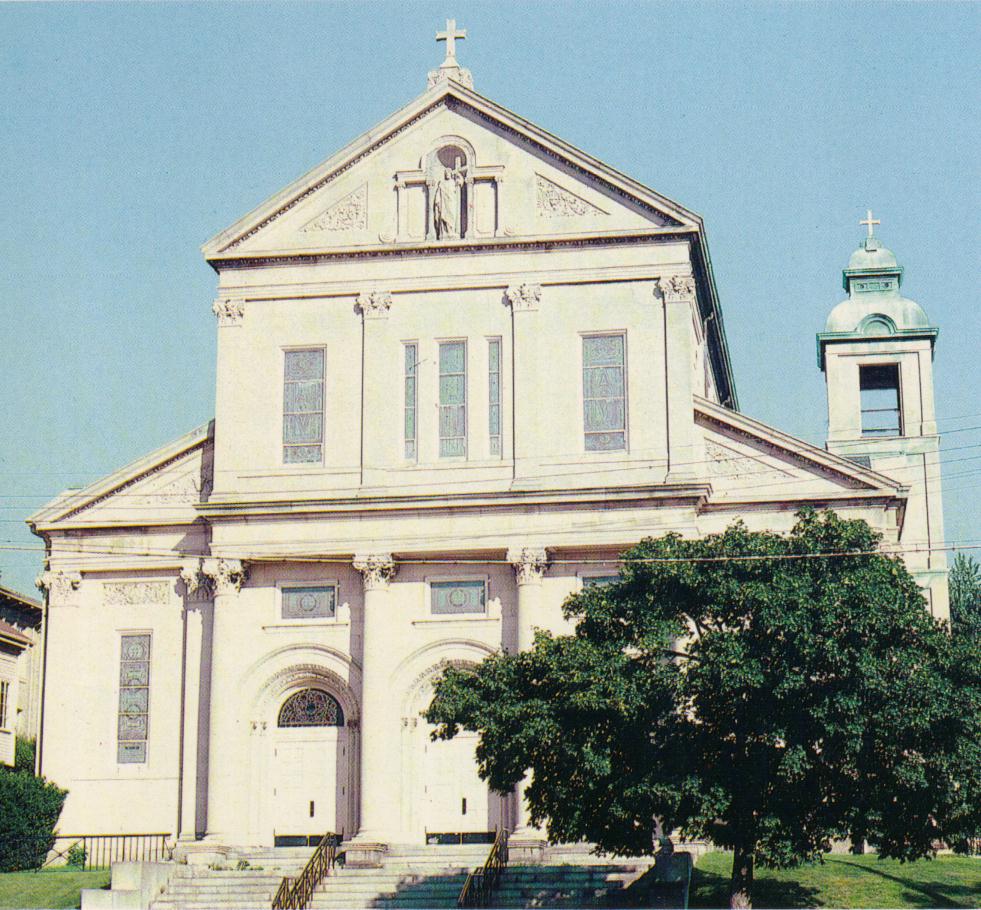 Today I attended the Extraordinary Form of Mass at one of my former parishes - Holy Name of Jesus in Providence, RI (pictured left). One thing I can say - after four years gone from there, you'd be surprised how many people stop you in your tracks before AND after Holy Mass, "Hi Brian! How've you been?" It's an excellent parish with wonderful people. Very little has changed. The Worship III hymnals I successfully made the sales pitch for in the year 2000 are still the hymnals used for hymns in English. I was very elated not to see those scrapped. Jacob Stott, my successor at the console at Holy Name, has done wonderful work with the schola cantorum. That's another elation of mine - the fact that Holy Name is one of those rare parishes that, instead of hiring someone to undo what I have done there, hired someone to continue and grow on what I have done. Jacob has done very well in letting the existing music ministry blossom, and in the right direction.
The Mass schedule is a bit interesting, considering the parish demographics:
Saturday at 4 PM in the Lady Chapel (with music - the organ is a two manual, six rank Hook and Hastings tracker)
Sunday at 9 AM in the Main Church (Gospel Choir first three Sundays each month, traditional music with organ fourth and fifth Sundays)
Sunday at 11 AM in the Main Church (Extraordinary Form, that is, the 1962 Roman Missal - High Mass Sept. through Corpus Christi, Low Mass during the Summer)
Sunday at 12:30 PM in the Lady Chapel (African Catholic Community - mainly people from Liberia and Nigeria)
Anyhoo, here's the music list for the 11:00 Mass, in the Extraordinary Form for the First Sunday of Advent (High Mass), which included two motets by William Byrd:
Mass Ordinary: Mass XVII (per Dominiciis Adventi et Quadragesimae) - perfect choice!
Asperges Me: Mode VII
Credo III
Mass Propers: all chanted to Psalm Tone 8G
Veni, Veni, Emmanuel...Mode I (a cappella, schola in procession)
Non Nobis, Domine...William Byrd (Offertory Motet)
Ave Verum...William Byrd (Communion Motet)
Alma Redemptoris Mater...Mode V (following the Last Gospel)
When the King Shall Come Again..."Gaudeamus Pariter" (Recessional)
Peace,
BMP
Subscribe to:
Posts (Atom)