RSCT to our NLM friend Jeffrey Tucker.
Pastoral Music, the official cat box liner of NaPalM, is promoting liturgical ensembles in the mag's most recent issue. Of course, here is their idea of liturgical ensembles:
The cover has a flute player in a jeans jacket playing next to two cellists in front of a youth choir. Page 14 has a guitar player with a conga player. Page 17 has two guitar players and a conga player. Page 18 features a guitar player. Page 22 has three bongo players. Page 24 has two flute players with a recorder player in front of a youth choir. Page 26 has a cellist and a violinist. Page 27 has a string bass player plucking his instrument. Page 28 has two guitar players with singers crowded around microphones. Page 31 has a pianist with a clarinetist, two flute players, a violist, and a trumpet player. Page 33 shows another flute player. Page 34 has two guitar players. Page 38 has two guitar players with a recorder player and two singers. Page 52 has a cantor in the "touchdown" position.
I think the "touchdown position" line is hilarious. I'm LMAO here!
OK, where the hell is the organ with any of this? Yeah, I'm talking about the "king of instruments", the instrument that the Second Vatican Council stated very clearly is "to be held in high esteem", doncha know?
Also in said issue are "excerpts" from Pope Pius XII's document Mediator Dei. I haven't seen the article, but Jeffrey mentions that the excerpts selected were agenda driven. Why am I NOT surprised? After all, this is NaPalM that we're talking about here.
Jeffrey writes:
But this sort of editorial manipulation really has no place in materials that are distributed with the stated goal of helping Church musicians do what the Church intends.
You and I both know that. I'm sure they do too. But do they care? Nah! People on their message boards will simply refer to Vatican authority figures as "clueless". I was on the boards from 1998 to 2006 (with a brief boot in late 2003-mid 2004). I've seen these things happen.
Kudos to Mr. Tucker for yet another excellent take!
Peace,
BMP

Showing posts with label NPM. Show all posts
Showing posts with label NPM. Show all posts
Friday, August 22, 2008

Monday, December 3, 2007
PASTORAL MUSIC MAGAZINE ARCHIVE
NaPalM has just opened its doors to the entire archive of back issues to its periodical, Pastoral Music. This could make for some interesting research.
As Jeffrey Tucker writes in NLM, "I'm grateful for these archives because a thorough understanding of what went wrong is an important component to having a clear view of the future."
Fully agreed, Jeffrey.
Peace,
BMP (who will be checking out that archives after I finish combing through Sing to the Lord)
As Jeffrey Tucker writes in NLM, "I'm grateful for these archives because a thorough understanding of what went wrong is an important component to having a clear view of the future."
Fully agreed, Jeffrey.
Peace,
BMP (who will be checking out that archives after I finish combing through Sing to the Lord)
Friday, August 17, 2007
Trouble in Paradise?
I just received a packet of "items" sung by the choir at Fr. Russo's previous parish. Among them was an abundance of Haugen/Haas and a couple Christopher Walker ditties (GIA and OCP abounding, and of course the ubiquitous "illegal copies" that generally accompany actual printed muzak from those organizations). Perhaps the best approach will be to cite the publishers' and the come-posers' links to NPM as a starting place to express the fact that such schlock is anathema in the Fatima choir library. Something like saying "he's a Freemason", or "He's a grand wizard of the KKK." At any rate, the music department is broke (hat tip to office renovations), so we won't be purchasing any of these lovely cow patties any time soon, anyway. And this Director of Music is not copying GIA scores of Now We Complain. I'd rather chew Reynolds wrap. Plus, such an action would not be in keeping with my good standing as a member of the Society for the Moratoreum on the Myoozik of Haugen/Haas.
I still laugh, fondly remembering that the local NPMers hosted good Chris Walker a few years ago. They even put together a kwyer for him to conduct to yodle his toonz. They used Fatima Church as their venue (not because it's organist is a member, but just because it's the largest church in the diocese and they wanted to impress their "guest my-strow". The Fatima organist was conspicuously absent for the performance). When the gig was over, the local NPM high priestesses were shocked and dismayed that good Chris actually wanted to sell his CD's and such. They actually thought (does the N in NPM stand for naive? It must!) that Chrisy-pie was in Lafayette not for the money, but because he was such an excellent pastoral (barf!) musician. Zoinks.
The packet of cow dung will remain atop my filing cabinet comprehensively to Gather dust (pardon the pun).
I still laugh, fondly remembering that the local NPMers hosted good Chris Walker a few years ago. They even put together a kwyer for him to conduct to yodle his toonz. They used Fatima Church as their venue (not because it's organist is a member, but just because it's the largest church in the diocese and they wanted to impress their "guest my-strow". The Fatima organist was conspicuously absent for the performance). When the gig was over, the local NPM high priestesses were shocked and dismayed that good Chris actually wanted to sell his CD's and such. They actually thought (does the N in NPM stand for naive? It must!) that Chrisy-pie was in Lafayette not for the money, but because he was such an excellent pastoral (barf!) musician. Zoinks.
The packet of cow dung will remain atop my filing cabinet comprehensively to Gather dust (pardon the pun).
Monday, August 6, 2007
NaPalM STRIKES AGAIN
Leave it to those guys to twist things around - like the demands of a liturgy document such as Liturgiam Authenticam. This from Chironomo:
The most recent edition of Pastoral Music (August-September 2007) is a fascinating read for those who are accustomed to the usual fare given in this publication. Nearly the entire edition is concerned with musical reform, however the concept of musical reform is never mentioned…not even once! Instead, there seems to be a movement here to make it seem as though all of these innovative ideas are coming from the minds at NPM. (Yeah, and maybe screw a few more things up in the process while they're at it!)
Michael McMahon, President of NPM, pens a curious look at the Directory for Music suggested by the Bishops in November of 2006 in “Establishing Criteria for Liturgical Songs”. From the outset, he misses the point entirely…. Liturgiam Authenticam doesn’t call for establishing criteria for liturgical songs… it calls for establishing a fixed repertoire of liturgical texts to be used for singing. There is a huge difference, which apparently the Bishops missed as well. (OK - so who started it? The Bishops or NaPalM?)
Click here to read the rest of the story.
Also, a big RSCT to Dad29, who not only points out Chironomo's post, but adds:
Given the inclinations of the current Pope, NAP(AL)M might be ceding membership to the Church Music Association of America over the next 10 years, because CMAA actually gets it.
The CMAA, however, would have to keep those faithful NaPalM'ers on a short leash.
Peace,
BMP
The most recent edition of Pastoral Music (August-September 2007) is a fascinating read for those who are accustomed to the usual fare given in this publication. Nearly the entire edition is concerned with musical reform, however the concept of musical reform is never mentioned…not even once! Instead, there seems to be a movement here to make it seem as though all of these innovative ideas are coming from the minds at NPM. (Yeah, and maybe screw a few more things up in the process while they're at it!)
Michael McMahon, President of NPM, pens a curious look at the Directory for Music suggested by the Bishops in November of 2006 in “Establishing Criteria for Liturgical Songs”. From the outset, he misses the point entirely…. Liturgiam Authenticam doesn’t call for establishing criteria for liturgical songs… it calls for establishing a fixed repertoire of liturgical texts to be used for singing. There is a huge difference, which apparently the Bishops missed as well. (OK - so who started it? The Bishops or NaPalM?)
Click here to read the rest of the story.
Also, a big RSCT to Dad29, who not only points out Chironomo's post, but adds:
Given the inclinations of the current Pope, NAP(AL)M might be ceding membership to the Church Music Association of America over the next 10 years, because CMAA actually gets it.
The CMAA, however, would have to keep those faithful NaPalM'ers on a short leash.
Peace,
BMP
Tuesday, July 24, 2007
COMPOSER OF THE YEAR???
Ah yes - OCP's pick as (de)Composer of the Year at the latest NaPalM convention in Indy - who other than Marty Haugen! (RSCT to the Curt Jester)
Here we learn that Haugen came into working with liturgy not knowing a thing about it. (RSCT to Domini Sumus).
"A chaplain suggested that I apply for a Catholic church job. I said I didn’t know anything about the Catholic liturgy, and he said, well, these days, nobody does—you’ll feel right at home. And he was right."
"Growing up in the Lutheran Church, I knew and loved the psalms, but only as prayer texts and spoken texts, not sung. The first Sunday I came to the Catholic church, we were instructed to sing the psalm—interactively! I was struck during that service by how badly the people sang and how poorly written the psalm setting was. It was awful. I thought to myself—I could write this badly!"
And he does write that badly. Worse, his thinking on liturgy was from a Lutheran standpoint, and he inflicted that same thinking on Catholic liturgy - most contrary to what the Vatican teaches us.
What the hell was that chaplain thinking? And even today, what the hell is OCP thinking? I shouldn't be surprised, I guess. After all, "All Are Welcome" seems to be the typical liturgical intelligence these days.
 Thank God for the Motu Proprio! While Haugen and pals are entertaining, we'll be worshipping!
Peace,
BMP
Here we learn that Haugen came into working with liturgy not knowing a thing about it. (RSCT to Domini Sumus).
"A chaplain suggested that I apply for a Catholic church job. I said I didn’t know anything about the Catholic liturgy, and he said, well, these days, nobody does—you’ll feel right at home. And he was right."
"Growing up in the Lutheran Church, I knew and loved the psalms, but only as prayer texts and spoken texts, not sung. The first Sunday I came to the Catholic church, we were instructed to sing the psalm—interactively! I was struck during that service by how badly the people sang and how poorly written the psalm setting was. It was awful. I thought to myself—I could write this badly!"
And he does write that badly. Worse, his thinking on liturgy was from a Lutheran standpoint, and he inflicted that same thinking on Catholic liturgy - most contrary to what the Vatican teaches us.
What the hell was that chaplain thinking? And even today, what the hell is OCP thinking? I shouldn't be surprised, I guess. After all, "All Are Welcome" seems to be the typical liturgical intelligence these days.
Thank God for the Motu Proprio! While Haugen and pals are entertaining, we'll be worshipping!Peace,
BMP
Saturday, July 14, 2007
CHANT SESSION CANCELLED AT N(a)P(al)M
...according to this thread. That is, the N(a)P(al)M convention in Indy this year.
My big $64,000 question is... WHY AM I NOT SURPRISED?
Peace,
BMP
My big $64,000 question is... WHY AM I NOT SURPRISED?
Peace,
BMP
Wednesday, May 9, 2007
WHY THE %^(& AM I NOT SURPRISED?
This was found in the website of the Archdiocese of Indianapolis (Red Sox cap tip to Argent).
In the next two years, the way that many people experience liturgy in the archdiocese and across the United States will undergo significant changes.
A new text for the Mass will be implemented, and a new Directory for Music and the Liturgy will guide bishops in their review of texts for songs used in the liturgy.
Included in the directory will be a list of standard hymns and songs that will be required to be in all future hymnals and missalettes.
The next few paragraphs go to tell about the infamous "what makes you sing" surveys and such, then goes on to the awards that will be given:
Father J. Michael Joncas, a liturgical music composer and a faculty member at the University of St. Thomas in St. Paul, Minn., will receive the NPM’s Jubilate Deo Award, which is given annually to a person who has made a significant contribution to the development of pastoral liturgy or music on the national or international level.
The NPM’s Pastoral Musician of the Year will be awarded to well-known liturgical composer Marty Haugen, also of Minnesota.
Sure - the composer of that lush love song Eagle's Wings and the one single solitary non-Catholic composer who has done more damage to liturgical music programs with his pen than any of the Catholic composers (though a few of them come damn close)! Oh wait - these awards are coming from NaPalM. Why should I be surprised?
(Note: Fr. Joncas does have a good share of very good, but underrated and underexposed, pieces - namely Lord, You Have the Words and As the Watchman, but has instead gained his reputation as a composer with the highly overrated and overplayed Eagle's Wings.)
Peace,
BMP
In the next two years, the way that many people experience liturgy in the archdiocese and across the United States will undergo significant changes.
A new text for the Mass will be implemented, and a new Directory for Music and the Liturgy will guide bishops in their review of texts for songs used in the liturgy.
Included in the directory will be a list of standard hymns and songs that will be required to be in all future hymnals and missalettes.
The next few paragraphs go to tell about the infamous "what makes you sing" surveys and such, then goes on to the awards that will be given:
Father J. Michael Joncas, a liturgical music composer and a faculty member at the University of St. Thomas in St. Paul, Minn., will receive the NPM’s Jubilate Deo Award, which is given annually to a person who has made a significant contribution to the development of pastoral liturgy or music on the national or international level.
The NPM’s Pastoral Musician of the Year will be awarded to well-known liturgical composer Marty Haugen, also of Minnesota.
Sure - the composer of that lush love song Eagle's Wings and the one single solitary non-Catholic composer who has done more damage to liturgical music programs with his pen than any of the Catholic composers (though a few of them come damn close)! Oh wait - these awards are coming from NaPalM. Why should I be surprised?
(Note: Fr. Joncas does have a good share of very good, but underrated and underexposed, pieces - namely Lord, You Have the Words and As the Watchman, but has instead gained his reputation as a composer with the highly overrated and overplayed Eagle's Wings.)
Peace,
BMP
Thursday, May 3, 2007
THIS SOUNDS ABOUT RIGHT
Jeffrey Tucker on the NaPalM convention:
"It seems that the authentic music of the Church that is intimately linked to the Mass itself is making a brief and hesitant appearance as part of a vast range of options, like one of a thousand side dishes in a massive all-you-can-eat buffet."
Yup - in other words, pretty like a cameo. Jeff's about got that right. Supposedly they do workshops on chant, but you hardly ever hear about it because they're buried behind cantor (read: arm flapping) and guitar workshops, as well as showcases by the publishers and composers of the "greatest hits" fare.
In fact, the NPM "Institutes" posted at this time at their site are:
"Cantor Express"
"Choir Director Institute"
"Music with Children"
"Guitar and Ensemble"
"Pastoral Liturgy"
No chant. No organ. And I shutter to picture their definition of "Pastoral". Considering I used to post on their message board (for about six years), I am NOT sold.
Peace,
BMP
"It seems that the authentic music of the Church that is intimately linked to the Mass itself is making a brief and hesitant appearance as part of a vast range of options, like one of a thousand side dishes in a massive all-you-can-eat buffet."
Yup - in other words, pretty like a cameo. Jeff's about got that right. Supposedly they do workshops on chant, but you hardly ever hear about it because they're buried behind cantor (read: arm flapping) and guitar workshops, as well as showcases by the publishers and composers of the "greatest hits" fare.
In fact, the NPM "Institutes" posted at this time at their site are:
"Cantor Express"
"Choir Director Institute"
"Music with Children"
"Guitar and Ensemble"
"Pastoral Liturgy"
No chant. No organ. And I shutter to picture their definition of "Pastoral". Considering I used to post on their message board (for about six years), I am NOT sold.
Peace,
BMP
Monday, March 20, 2006
EAGLE'S WINGS - SHOULD THEY BE CLIPPED?
Two related posts from Musica Sacra!
First, the letter written and sent to Catholic New York by organist/choirmaster David Hughes. Click here to read this well-put letter.
Then, read this take from the composer himself, Michael Joncas, found in OCP's planning guide Today's Liturgy. At the same time, Fr. Joncas doesn't think that certain liturgy documents, namely the IGMR, Liturgiam Authenticam, and Redemptionis Sacramentum, should be taken too seriously. Well, that sounds like some of the posters I know (I won't mention names) on the NPM message boards. They'll take Fr. Funk's brainwashings over the teachings of Holy Mother Church and her authorities. More on that in later posts.
Note: not everyone on the NPM boards are bad. The bad ones, however, outweigh the good in voice and in clout. More later.
Peace,
BMP
First, the letter written and sent to Catholic New York by organist/choirmaster David Hughes. Click here to read this well-put letter.
Then, read this take from the composer himself, Michael Joncas, found in OCP's planning guide Today's Liturgy. At the same time, Fr. Joncas doesn't think that certain liturgy documents, namely the IGMR, Liturgiam Authenticam, and Redemptionis Sacramentum, should be taken too seriously. Well, that sounds like some of the posters I know (I won't mention names) on the NPM message boards. They'll take Fr. Funk's brainwashings over the teachings of Holy Mother Church and her authorities. More on that in later posts.
Note: not everyone on the NPM boards are bad. The bad ones, however, outweigh the good in voice and in clout. More later.
Peace,
BMP
Friday, March 17, 2006
COMPARISON SHOPPING

VERSUS

One does more to restore the sacred.
One does more to promote faithfulness to the liturgy documents as prescribed by the USCCB, BCL, the Vatican, and the Holy See.
One's dues are $60 a year less than the other.
One takes the word of a Vatican Official (e.g., the Prefect for the Congregation of Divine Worship and Sacraments) over the brainwashings of a certain organization's founders, favored publishers, and favored songwriters and liturgist wannabes.
One can handle the Truth!
That "One" is the same person in all five of the above sentences. See if you can guess which one it is. There is only ONE clear choice!
Peace,
BMP
Thursday, March 9, 2006
NPM'S GOLDEN CALF: THE RIGHT QUESTIONS AND MAKE-BELIEVE ANSWERS
Faust: Ich bin’s, bin Faust, bin deinesgleichen!
Geist: Du gleichst dem Geist, den du begreifst,
Nicht mir!
Goethe, Faust I, 500, 512-513
Not an organization member myself, and therefore not entitled to receive it in print format, a few weeks ago, I was sent the PDF file of the article from the February-March 2006 edition of Pastoral Music, the journal of the National Association of Pastoral Musicians, which reported on its recent poll. The poll sought to determine what religious “songs” were the most popular among American Roman Catholics. I had learned about the poll from colleagues and was happy to provide a few titles of anthems, motets, and congregational hymns which seemed to fulfill the NPM’s queries. This particular poll seemed quite interesting to me, mostly because I wondered who it was who would respond to it. Surely the membership of the NPM would, and that full-heartedly. But what of the others? (There are indeed others, mirabile dictu.) Judging from the red herring titles in the batch of poll results, I suppose that a number of us non-NPMer’s did indeed respond. It would have been foolish to assume that the majority of respondents were not members of that organization itself, and that ultimately, the poll results would have been any less predictable.
Eagerly, I read the report and reviewed the list of “songs” which made the NPM “A” list. No surprises. Even less surprising was the fact that no consequential conclusion had been drawn from the poll, for whatever reason, if nothing else than to see in print “On Eagle’s Wings” listed in the #1 spot. The points made in the preliminary material accompanying the results could just as easily have been made without a poll. The NPM found that the music mentioned by those polled reflected 1) a very wide variety of songs (just like our two-century treasury of Catholic vocal music – no poll required), 2) a variety of musical styles (again, like the treasury of Catholic vocal music. Also, exactly like the radio stations set on my car stereo – no poll required), 3) an association with significant events (I have yet to meet anyone for whom some music carries no connection with particular life-events. The entire CD of “Goodbye, Yellow Brick Road”, for example, reminds me fiercely of my college days and of late-night thesis-writing – no poll required), and 4) an association with childhood experiences (really, this is the same as conclusion #3, but with a bit more nostalgia – poets throughout time have marveled at youth, longed for its return, and mourned its passing: A.E. Houseman, to cite just one example, makes that clear enough. “Schmücke Dich” still reminds this author of long waits while the communion rail filled and emptied, shifts of adults communing, returning to the pews – no poll required).
The poll is entitled “Songs That Make a Difference.” But honestly: a difference in what? In faith? In religious zeal? In devotion? And even further: what difference? Between worship styles? Between denominational liturgies? Between one musical selection and another? Between one composer and another? The article’s authors offer this insight:
Funeral celebrations were by far the most commonly cited occasions on which a
particular song made a lasting effect.
The death of a loved one is without question a most trying time: continuing to live without the physical presence of one departed. As Kübler-Ross outlined years ago in her famous study, we humans take time to re-adjust to this new circumstance, not necessarily physically, but emotionally. We naturally move through various stages, eventually to arrive, either on our own or with assistance, to accept the loss. The power of emotion is fierce. Likewise is the power of music. It takes no specialized knowledge other than a familiarity with the human condition to realize that when one is emotionally raw, one may find comfort in music. I am reminded here of the lyre cartouche which appears on the familiar yellow covers of G. Schirmer scores, which bears the motto that music is the “dulce lenimen”: the “sweet solace”. Emotion is clearly not the soundest foundation upon which to conclude anything, and certainly not proof of the popularity of musical works, either sacred or secular – since music cuts, as it were, “too close to the quick.” I beg the reader’s forgiveness at this point to indulge me the opportunity briefly to digress. I find attachment to two secular items which I associate with the death of my father: the song “La Paloma”, which, according to my mother, he had said was the “most beautiful song in the world” and to which he loved to dance with her. Also, the Toccata movement from the Widor Organ Symphony No. 5, which I played onto a tape along with a recording of La Paloma and some other items for my father to listen to as he lay dying. Even as I write, I grow teary with emotion at the memory of his stirring in the coma as the Spanish words of La Paloma drifted from the tape recorder, and especially in recalling when my mother said, “You hear the organ Toccata? It’s our little Jason playing for you.” (I had by then, of course, outgrown my littleness, although not in my mother’s eyes). Despite my emotional attachment to these two items, neither is more or less important or popular in the musical macrocosm. La Paloma remains a beautiful song to some, possibly unknown to others, and the Widor Fifth remains a composition of the French organ repertoire which many enjoy, which some dislike, which some have never heard or played.
In the final brief section of the actual poll commentary, the article’s authors make this statement:
…musicians and other pastoral leaders should be attentive to the many different
musical styles that nourish and support the faith of American Catholics, taking care
not merely to choose music from our own personal taste but to make selections
out of a pastoral concern [italics added] for the members of our communities.
I believe this to be very true, yet not in the context of the NPM report. Taking into account the importance placed indirectly on the role of emotion in musical selection and popularity earlier in the report, were a Church musician to take this statement in the NPM context, he would pastorally dupe his flock, exchanging with them an opportunity rightly to worship the Almighty in song, for an opportunity to prey upon their emotions. Allowing emotion to be guide in music selection discards the Almighty as the focus of worship and sets before the worshiping congregation a glass in which they may see themselves and their emotional states reflected. As the sacrificial species are elevated and transformed upon the altar of the Most High, the golden calf of Self is hoisted high amidst a frolicking and wreathed assembly drunk on emotion, whirling in narcissistic frenzy.
This emotion-based outlook is nothing new. One need only recall the Roman poet Catullus’ description of the initiation rites into the Cult of Cybele, during which, hypnotized by emotion (we would patronizingly term it “charismaticism” or “being spirit-filled” today), the spinning initiate, Attis by name, grasps in hand a razor-sharp flint and therewith castrates himself. (Catullus 63). Awakening from his stupor, he later bemoans the loss of his manhood.
Were one to base musical selection upon true pastoral concern, emotion should and must play no part in the decision-making. Rather, the liturgy itself and the lessons from Scripture must be the guides. That which fosters worship of the Almighty is the clear choice, “the music”, as Pope Benedict XVI states in Geist der Liturgie, “of the Sursum Corda, the lifting up of hearts.” Selecting music simply because “the assembly like it” is a very dangerous game which has but one outcome: a rendering impotent both of music director and of worship: the eunuch shepherd leads the flock to graze upon sand in the wasteland. As human beings, it is neighborly to be concerned about the emotional well-being of others, however as Church musicians (and, to join the trendy set, as “pastoral musicians”), we are to be most attentive to the worship of God by the faithful through music. The faithful must not sing or play instruments in a liturgical context in order to “feel good” about themselves, but to worship God. If all that Sunday morning means is “assembly” and “building community”, we may as well meet not in a church at all, but at a community center for coffee/donuts. Calvary was not necessary merely to build fellowship. The second table of the Decalogue, may we remind ourselves, deals with nothing else but love of neighbor. This we knew from Sinai, generations before the Cenacle, Gabbatha, and the Skull Place. Nor is fellowship something particularly Christian: the pagan Trimalchio certainly enjoyed more than a share of fellowship at his colorful assemblies. The Cliché is true: Holy Mass is not about what we “get out of it”, but what we “put into it”. I certainly am thankful that Christ the Lord in Gethsemane did not ask, “Father, what’s in it for me?”
Ironically, the NPM staff continue: “We should ask ourselves if these songs are able to bear the weight of inspiring and sustaining faith.” And this: “Are we introducing our children to repertoire that can last a lifetime?” These are indeed the correct questions to pose. As more and more youth and young adults smirk at the liturgo-pop of Landry, Haugen, Haas, and others, we are left to wonder also, how long will the popularity last? We stand before two altars, one of Baal and one of the God of Israel, waiting for the fire with the prophet of old. If use of the Bach B minor Mass at the recent World Youth Day in Cologne, Germany teaches us anything at all, we should already know the answers to the important questions posed by the NPM staff. Now I ask the NPM: are you ready to extricate your heads from the sand and to stand up to the challenge? Useful to know: the Bärenreiter score of the B minor is not available from OCP or GIA, but you can pick one up at your local music shop for about $20. See you at rehearsal, Mr. Funk.
Geist: Du gleichst dem Geist, den du begreifst,
Nicht mir!
Goethe, Faust I, 500, 512-513
Not an organization member myself, and therefore not entitled to receive it in print format, a few weeks ago, I was sent the PDF file of the article from the February-March 2006 edition of Pastoral Music, the journal of the National Association of Pastoral Musicians, which reported on its recent poll. The poll sought to determine what religious “songs” were the most popular among American Roman Catholics. I had learned about the poll from colleagues and was happy to provide a few titles of anthems, motets, and congregational hymns which seemed to fulfill the NPM’s queries. This particular poll seemed quite interesting to me, mostly because I wondered who it was who would respond to it. Surely the membership of the NPM would, and that full-heartedly. But what of the others? (There are indeed others, mirabile dictu.) Judging from the red herring titles in the batch of poll results, I suppose that a number of us non-NPMer’s did indeed respond. It would have been foolish to assume that the majority of respondents were not members of that organization itself, and that ultimately, the poll results would have been any less predictable.
Eagerly, I read the report and reviewed the list of “songs” which made the NPM “A” list. No surprises. Even less surprising was the fact that no consequential conclusion had been drawn from the poll, for whatever reason, if nothing else than to see in print “On Eagle’s Wings” listed in the #1 spot. The points made in the preliminary material accompanying the results could just as easily have been made without a poll. The NPM found that the music mentioned by those polled reflected 1) a very wide variety of songs (just like our two-century treasury of Catholic vocal music – no poll required), 2) a variety of musical styles (again, like the treasury of Catholic vocal music. Also, exactly like the radio stations set on my car stereo – no poll required), 3) an association with significant events (I have yet to meet anyone for whom some music carries no connection with particular life-events. The entire CD of “Goodbye, Yellow Brick Road”, for example, reminds me fiercely of my college days and of late-night thesis-writing – no poll required), and 4) an association with childhood experiences (really, this is the same as conclusion #3, but with a bit more nostalgia – poets throughout time have marveled at youth, longed for its return, and mourned its passing: A.E. Houseman, to cite just one example, makes that clear enough. “Schmücke Dich” still reminds this author of long waits while the communion rail filled and emptied, shifts of adults communing, returning to the pews – no poll required).
The poll is entitled “Songs That Make a Difference.” But honestly: a difference in what? In faith? In religious zeal? In devotion? And even further: what difference? Between worship styles? Between denominational liturgies? Between one musical selection and another? Between one composer and another? The article’s authors offer this insight:
Funeral celebrations were by far the most commonly cited occasions on which a
particular song made a lasting effect.
The death of a loved one is without question a most trying time: continuing to live without the physical presence of one departed. As Kübler-Ross outlined years ago in her famous study, we humans take time to re-adjust to this new circumstance, not necessarily physically, but emotionally. We naturally move through various stages, eventually to arrive, either on our own or with assistance, to accept the loss. The power of emotion is fierce. Likewise is the power of music. It takes no specialized knowledge other than a familiarity with the human condition to realize that when one is emotionally raw, one may find comfort in music. I am reminded here of the lyre cartouche which appears on the familiar yellow covers of G. Schirmer scores, which bears the motto that music is the “dulce lenimen”: the “sweet solace”. Emotion is clearly not the soundest foundation upon which to conclude anything, and certainly not proof of the popularity of musical works, either sacred or secular – since music cuts, as it were, “too close to the quick.” I beg the reader’s forgiveness at this point to indulge me the opportunity briefly to digress. I find attachment to two secular items which I associate with the death of my father: the song “La Paloma”, which, according to my mother, he had said was the “most beautiful song in the world” and to which he loved to dance with her. Also, the Toccata movement from the Widor Organ Symphony No. 5, which I played onto a tape along with a recording of La Paloma and some other items for my father to listen to as he lay dying. Even as I write, I grow teary with emotion at the memory of his stirring in the coma as the Spanish words of La Paloma drifted from the tape recorder, and especially in recalling when my mother said, “You hear the organ Toccata? It’s our little Jason playing for you.” (I had by then, of course, outgrown my littleness, although not in my mother’s eyes). Despite my emotional attachment to these two items, neither is more or less important or popular in the musical macrocosm. La Paloma remains a beautiful song to some, possibly unknown to others, and the Widor Fifth remains a composition of the French organ repertoire which many enjoy, which some dislike, which some have never heard or played.
In the final brief section of the actual poll commentary, the article’s authors make this statement:
…musicians and other pastoral leaders should be attentive to the many different
musical styles that nourish and support the faith of American Catholics, taking care
not merely to choose music from our own personal taste but to make selections
out of a pastoral concern [italics added] for the members of our communities.
I believe this to be very true, yet not in the context of the NPM report. Taking into account the importance placed indirectly on the role of emotion in musical selection and popularity earlier in the report, were a Church musician to take this statement in the NPM context, he would pastorally dupe his flock, exchanging with them an opportunity rightly to worship the Almighty in song, for an opportunity to prey upon their emotions. Allowing emotion to be guide in music selection discards the Almighty as the focus of worship and sets before the worshiping congregation a glass in which they may see themselves and their emotional states reflected. As the sacrificial species are elevated and transformed upon the altar of the Most High, the golden calf of Self is hoisted high amidst a frolicking and wreathed assembly drunk on emotion, whirling in narcissistic frenzy.
This emotion-based outlook is nothing new. One need only recall the Roman poet Catullus’ description of the initiation rites into the Cult of Cybele, during which, hypnotized by emotion (we would patronizingly term it “charismaticism” or “being spirit-filled” today), the spinning initiate, Attis by name, grasps in hand a razor-sharp flint and therewith castrates himself. (Catullus 63). Awakening from his stupor, he later bemoans the loss of his manhood.
Were one to base musical selection upon true pastoral concern, emotion should and must play no part in the decision-making. Rather, the liturgy itself and the lessons from Scripture must be the guides. That which fosters worship of the Almighty is the clear choice, “the music”, as Pope Benedict XVI states in Geist der Liturgie, “of the Sursum Corda, the lifting up of hearts.” Selecting music simply because “the assembly like it” is a very dangerous game which has but one outcome: a rendering impotent both of music director and of worship: the eunuch shepherd leads the flock to graze upon sand in the wasteland. As human beings, it is neighborly to be concerned about the emotional well-being of others, however as Church musicians (and, to join the trendy set, as “pastoral musicians”), we are to be most attentive to the worship of God by the faithful through music. The faithful must not sing or play instruments in a liturgical context in order to “feel good” about themselves, but to worship God. If all that Sunday morning means is “assembly” and “building community”, we may as well meet not in a church at all, but at a community center for coffee/donuts. Calvary was not necessary merely to build fellowship. The second table of the Decalogue, may we remind ourselves, deals with nothing else but love of neighbor. This we knew from Sinai, generations before the Cenacle, Gabbatha, and the Skull Place. Nor is fellowship something particularly Christian: the pagan Trimalchio certainly enjoyed more than a share of fellowship at his colorful assemblies. The Cliché is true: Holy Mass is not about what we “get out of it”, but what we “put into it”. I certainly am thankful that Christ the Lord in Gethsemane did not ask, “Father, what’s in it for me?”
Ironically, the NPM staff continue: “We should ask ourselves if these songs are able to bear the weight of inspiring and sustaining faith.” And this: “Are we introducing our children to repertoire that can last a lifetime?” These are indeed the correct questions to pose. As more and more youth and young adults smirk at the liturgo-pop of Landry, Haugen, Haas, and others, we are left to wonder also, how long will the popularity last? We stand before two altars, one of Baal and one of the God of Israel, waiting for the fire with the prophet of old. If use of the Bach B minor Mass at the recent World Youth Day in Cologne, Germany teaches us anything at all, we should already know the answers to the important questions posed by the NPM staff. Now I ask the NPM: are you ready to extricate your heads from the sand and to stand up to the challenge? Useful to know: the Bärenreiter score of the B minor is not available from OCP or GIA, but you can pick one up at your local music shop for about $20. See you at rehearsal, Mr. Funk.
Thursday, March 2, 2006
Retrieving a Treasure
The following story from the Adoremus Bulletin was posted to the NPM Users List by a senior editor at one of The Big Three. I thought it would be of interest to those who frequent our corner of the internet. It is a report on the musical aspects of Liturgiam Authenticam, and the work being done by the BCL.
Retrieving a Treasure of Inestimable Value
Enjoy.
~nb
Retrieving a Treasure of Inestimable Value
Enjoy.
~nb
Saturday, February 25, 2006
Musical Heritage at Risk?
This just arrived in my mailbox courtesy of NPM, of all people.....
Martin Baker, Master of Music at London's Westminster Cathedral, argues that the musical heritage of the Catholic Church is in danger of being lost. Baker also contends that the practice of musical liturgy at Westminster Cathedral provides a model that deserves support from church leaders. Read his article, A Musical Heritage at Risk, that was recently published in the British Jesuit journal, The Tablet.
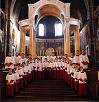
The Choir of Westminster Cathedral.
Martin Baker, Master of Music at London's Westminster Cathedral, argues that the musical heritage of the Catholic Church is in danger of being lost. Baker also contends that the practice of musical liturgy at Westminster Cathedral provides a model that deserves support from church leaders. Read his article, A Musical Heritage at Risk, that was recently published in the British Jesuit journal, The Tablet.
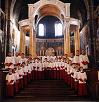
The Choir of Westminster Cathedral.
Friday, January 27, 2006
THE NPM SURVEY and the BIRD FLEW
For quite some time the National Pastoral Musicians have been running this survey asking to name a "song that made a difference".
Gerald at The Cafeteria is Closed had this to say:
"One has to look at the Eucharist, else things are just too discouraging."
This may seem true in many parishes, but there IS hope, Gerald. We have the right man on the Apostolic See. So, that's a help. There is talk of "crackdown". One only has to check out the PowerPoint presentation at the US Bishops Secretariat on Liturgy site to see that. How far it goes remains to be seen, of course. Our own Jason left a really good comment on Gerald's article.
Shawn at The New Liturgical Movement had this to say:
"At any rate, let's always remember as well that mere popularity is not the criteria for liturgical music. Its also about its formative power and appropriate character as regards the sacred liturgy, and not simply one's emotional attachment."
So right, Shawn! And think of this - one person once told me (on the NPM boards, too, believe it or not) that just because a song is in a hymnal doesn't necessarily mean it's fit for Holy Mass. Of course, this person was referring to Benediction/Adoration hymns. The same could be said for half of the top 25 on the "survey" - namely the banal little ditties got mentioned - like the top four, or, as Gerald mentioned, six of the top nine.
Fr. Kocik, at the diocese next door to me, had this to say in his comment on Shawn's article:
"On Eagle's Wings" so overused, one would think the Requiem Mass is more aptly called the "You Who" Mass (in keeping with the tradition of naming Masses according to the first words of the Introit)."
I also took the liberty of being the first to comment on Shawn's article:
"Your last comment is RIGHT ON THE MONEY! Funny the amount of calls I get for this one for funerals, especially considering I flatly refuse to use this (or any other of that Glory and Praise-like muzak) on Sundays - not even on the First Sunday of Lent, when every single proper in the Gregorian Missal - introit, gradual, tract, alleluia, offertory, and communion, is based on that Psalm."
On Eagle's Wings (to which a local organist friend of mine is familiar with a parody called "Beagle's Things") IS based on Psalm 91. It's too bad it sounds more like a "love ballad" than a hymn. Some good Psalm 91-based chants are right in your fingertips for just a little over thirty bucks. The source in question: The Gregorian Missal for Sundays! Look up the First Sunday of Lent - EVERY Proper for the day is Psalm 91-based. In fact, the Tract is the entire Psalm! Even better, you could sing the entire tract to a Psalm Tone for the sake of simplicity. Psalm Tone 2 is usually really good for that tract.
Even J. Michael McMahon, the NPM President, had this to say:
"Currently filling in as a parish choir director, McMahon said, "I'm always surprised how many young people ask for 'Ave Maria' or 'Panis Angelicus' at weddings and funerals."
Younger people are developing that "sense of the sacred", can you say? Younger priests are also promoting the sacred. My own pastor is not much older than me (hint: one of my mentors once told me when I told him my age, jokingly, of course, "you're still a punk!"). There are exceptions to this statement, but I can't say there are many. Restoration of the sacred is becoming far more vocal, thanks to the wonderful technological means we have called the Internet.
Over here at my parish, when it comes to eagle's wings, the "bird flew".
OR
In this parish, we have the cure for the "bird flu" of eagle's wings.
Peace,
BMP
Gerald at The Cafeteria is Closed had this to say:
"One has to look at the Eucharist, else things are just too discouraging."
This may seem true in many parishes, but there IS hope, Gerald. We have the right man on the Apostolic See. So, that's a help. There is talk of "crackdown". One only has to check out the PowerPoint presentation at the US Bishops Secretariat on Liturgy site to see that. How far it goes remains to be seen, of course. Our own Jason left a really good comment on Gerald's article.
Shawn at The New Liturgical Movement had this to say:
"At any rate, let's always remember as well that mere popularity is not the criteria for liturgical music. Its also about its formative power and appropriate character as regards the sacred liturgy, and not simply one's emotional attachment."
So right, Shawn! And think of this - one person once told me (on the NPM boards, too, believe it or not) that just because a song is in a hymnal doesn't necessarily mean it's fit for Holy Mass. Of course, this person was referring to Benediction/Adoration hymns. The same could be said for half of the top 25 on the "survey" - namely the banal little ditties got mentioned - like the top four, or, as Gerald mentioned, six of the top nine.
Fr. Kocik, at the diocese next door to me, had this to say in his comment on Shawn's article:
"On Eagle's Wings" so overused, one would think the Requiem Mass is more aptly called the "You Who" Mass (in keeping with the tradition of naming Masses according to the first words of the Introit)."
I also took the liberty of being the first to comment on Shawn's article:
"Your last comment is RIGHT ON THE MONEY! Funny the amount of calls I get for this one for funerals, especially considering I flatly refuse to use this (or any other of that Glory and Praise-like muzak) on Sundays - not even on the First Sunday of Lent, when every single proper in the Gregorian Missal - introit, gradual, tract, alleluia, offertory, and communion, is based on that Psalm."
On Eagle's Wings (to which a local organist friend of mine is familiar with a parody called "Beagle's Things") IS based on Psalm 91. It's too bad it sounds more like a "love ballad" than a hymn. Some good Psalm 91-based chants are right in your fingertips for just a little over thirty bucks. The source in question: The Gregorian Missal for Sundays! Look up the First Sunday of Lent - EVERY Proper for the day is Psalm 91-based. In fact, the Tract is the entire Psalm! Even better, you could sing the entire tract to a Psalm Tone for the sake of simplicity. Psalm Tone 2 is usually really good for that tract.
Even J. Michael McMahon, the NPM President, had this to say:
"Currently filling in as a parish choir director, McMahon said, "I'm always surprised how many young people ask for 'Ave Maria' or 'Panis Angelicus' at weddings and funerals."
Younger people are developing that "sense of the sacred", can you say? Younger priests are also promoting the sacred. My own pastor is not much older than me (hint: one of my mentors once told me when I told him my age, jokingly, of course, "you're still a punk!"). There are exceptions to this statement, but I can't say there are many. Restoration of the sacred is becoming far more vocal, thanks to the wonderful technological means we have called the Internet.
Over here at my parish, when it comes to eagle's wings, the "bird flew".
OR
In this parish, we have the cure for the "bird flu" of eagle's wings.
Peace,
BMP
Tuesday, November 15, 2005
IT'S ABOUT DANG TIME
Yes - as reported in The New Liturgical Movement - NPM is FINALLY promoting chant.
It's definitely a turn into the right direction, finally!
Read: Triumph of Hope at NPM
BMP
It's definitely a turn into the right direction, finally!
Read: Triumph of Hope at NPM
BMP
Subscribe to:
Posts (Atom)