I had commented earlier that I no longer had access to my 2008 music list, HOWEVER, one of the singers in the old Fatima choir sent me her copy in the mail yesterday! She has always been an avid reader of Christus Vincit. At any rate, these were my picks for last Sunday, Laetare, as well as Judica, this coming Sunday:
Laetare:
Ordinary: Missa 17
Int: In my distress (Flowing Waters -- FW)
Tract: Out of the depths (FW)
Off: O Rejoice, Ye Christians, Loudly, J.S. Bach
Comm: Thou Knowest Lord, Purcell
O Dearest Jesus, Crueger
Judica:
Ordinary: Missa 17
Int: O God, my God (FW)
Tract: Often have they attacked me (FW)
Off: What Have We Done? Hopson
Comm: Drop, Drop, Slow Tears, Powell
O Most Merciful, Munster Gesangbuch
My plan, you see, was to use the English plainchant through Lent and then to switch to the Latin chants for Holy Week. Well, while I'm at it, here's Palm Sunday as well:
Ordinary: Missa 17
Int: Hosanna filio David
Procession with palms: All Glory, Laud, and Honor
Tract: Christus factus est, Palestrina
Off: O Dearest Jesus, Thy Sacred Head, Johnson
Comm: How Like the Lovely Rose Tree, Young
Out of the Depths, Schalk

Showing posts with label Our Lady of Fatima Church. Show all posts
Showing posts with label Our Lady of Fatima Church. Show all posts
Friday, March 7, 2008

Monday, March 3, 2008
The Ghost of Laetare Past
Paula over at As We Wait reported the abysmal music offerings she encountered yesterday for Laetare. I had commented that I would post the music list I had originally planned, but, alas, it seems the list was worked out and typed up on the office computer this year, so, it is no longer available. I do, however, have a copy of last year's Laetare, Paula, for you to remember and compare to the doo-whop chorus you described. Here's Laetare 2007:
Ordinary: Missa XVII
Introit: Laetare Jerusalem
Gradual: Psalm of the day
Tract: Out of the depths (Flowing Waters, sung in English)
Offertory: The King of Love (ST. COLUMBA)
Herzliebster Jesus, was has du verbrochen? Johannes Brahms
Communion: Out of the Depths, Carl Schalk
O Father We Have Wandered (O HAUPT VOLL BLUT UND WUNDEN)
Postlude: Toccata Giocosa, William Mathias
Ordinary: Missa XVII
Introit: Laetare Jerusalem
Gradual: Psalm of the day
Tract: Out of the depths (Flowing Waters, sung in English)
Offertory: The King of Love (ST. COLUMBA)
Herzliebster Jesus, was has du verbrochen? Johannes Brahms
Communion: Out of the Depths, Carl Schalk
O Father We Have Wandered (O HAUPT VOLL BLUT UND WUNDEN)
Postlude: Toccata Giocosa, William Mathias
Thursday, February 21, 2008
A bit of Lafayette History
Back in 2003, great effort was expended in order to obtain relics of the Fatima visionaries Blessed Jacinta and Blessed Fransciso. The Bishop of our diocese wrote a letter in English which was then translated into Protugese to honor the local vernacular and into Latin as the official Church document in order to obtain these rarely translated relics. The petition was successful, and the relics can now be seen and venerated in Fatima Church, Lafayette. Below is the text of the offical Latin petition for the tranlsation of the relics (slivers of wood from the caskets of both children, and a splinter from the tree of aparition -- at the time, we did now know exactly what the relics would be. Although the text begs for primary relics, the rector of the shrine agreed to secondary relics). Yours truly composed the Latin text. The priest mentioned in the second half was a former associate priest at Fatima Church who was acting as the Bishop's legate. Other than clergymen, few have seen this petition or even know of its existence, but I think it is a bit of Lafayette history and is therefore of interest, as such protocols are very ancient, yet still very much current. Other than the original copy sent to Portugal, which was subsequently copied and sent to Rome, I doubt that any record or memory of the relics' history still exists at the Lafayette site where the relics are housed. I have a copy of the document, however, and am pleased to share it with you here:
HAC DIE 24 SEPTEMBRIS ANNO DOMINI 2003
CARISSIMO RECTORI REVERENDISSIMO PATRI FATIMAE URBE SANCTUARII DOMINAE NOSTRAE SALUTATIONES
Episcopo me ipso Diœcesis Lafayettiensis Louisianae Populo Dei ministrante, humiliter a te peto, ut me primi gradus reliquias potiri Beatae Iacintae et Beati Francisci adiuvares, duorum quibus imagine sui Virgo Beatissima Maria apparuerat. Has potiri et in Diœcesen Lafayettiensem reliquias transferre vellim ut eaedem in Ecclesia Dominae Nostrae Fatimae in Diœcese nostra posita ad publicum venerandum proponerentur proprio modo ut opus est secundum Codices Legum Canonicarum. Quia haec Parœcia apud primas Civitatibus in Unitis esset Nostrae Dominae sub Fatimae titulo dedicatae, quaedam reliquiae Beatae Iacintae Beatique Francisci mandatum et preces offerre et paenitentiam agere a Matre Beatissima Fatimae ad urbem relictum valdissime certissimeque dilatarent.
Reverendum Patrem Paulum Broussardum mandavi officialem meum legatum, qui reliquias percipiat easque in Diœcesen nostram transferrat. Me agente gratias, tibi alicui beneficio caritatis, quaecumque videatur optima, donum his cum litteris inclusum propter adiuvationem tuam praebeo.
Pro tuis intentionibus et quibusdam eorum, qui tua in cura congregati sunt, preces offero. Remaneo in Christo
EXCELLENTIA SUA
REVERENDISSIMUS MICHAEL JARRELL
EPISCOPUS LAFAYETTIENSIS LOUISIANAE
CARISSIMO RECTORI REVERENDISSIMO PATRI FATIMAE URBE SANCTUARII DOMINAE NOSTRAE SALUTATIONES
Episcopo me ipso Diœcesis Lafayettiensis Louisianae Populo Dei ministrante, humiliter a te peto, ut me primi gradus reliquias potiri Beatae Iacintae et Beati Francisci adiuvares, duorum quibus imagine sui Virgo Beatissima Maria apparuerat. Has potiri et in Diœcesen Lafayettiensem reliquias transferre vellim ut eaedem in Ecclesia Dominae Nostrae Fatimae in Diœcese nostra posita ad publicum venerandum proponerentur proprio modo ut opus est secundum Codices Legum Canonicarum. Quia haec Parœcia apud primas Civitatibus in Unitis esset Nostrae Dominae sub Fatimae titulo dedicatae, quaedam reliquiae Beatae Iacintae Beatique Francisci mandatum et preces offerre et paenitentiam agere a Matre Beatissima Fatimae ad urbem relictum valdissime certissimeque dilatarent.
Reverendum Patrem Paulum Broussardum mandavi officialem meum legatum, qui reliquias percipiat easque in Diœcesen nostram transferrat. Me agente gratias, tibi alicui beneficio caritatis, quaecumque videatur optima, donum his cum litteris inclusum propter adiuvationem tuam praebeo.
Pro tuis intentionibus et quibusdam eorum, qui tua in cura congregati sunt, preces offero. Remaneo in Christo
EXCELLENTIA SUA
REVERENDISSIMUS MICHAEL JARRELL
EPISCOPUS LAFAYETTIENSIS LOUISIANAE
Monday, July 23, 2007
Renovations, exams, and other things
You may have noticed my absence recently from blogging...not that I have chosen to be absent, but Fatima has been a very busy parish since Divine Mercy Sunday. Our new pastor is now building on the firm foundation set by Monsignor Provost, now Bishop Provost of Lake Charles. At the same time, the physical work in replacing the organ console began, and in the two months following, we have enjoyed a number of visits from technicians to work out computer bugs and minor tuning issues. We also hosted the Schantz voicers for two weeks as they went over the instrument with a fine toothed comb, tuning and voicing. Now, the parish offices are being completely renovated. The music office has a new coat of BVM Blue paint, but still has no carpet. In order to save some cash, the professional painters worked the ceilings of the office building and painted the central atrium, while the staff were resposible for their own office walls and those of whatever remaining offices needed to be painted. In 1.5 weeks, the DRE, the parish secretary, the pastor, and I painted 6 spacious offices. The Social Service woman and and the bookkeeper only painted their own offices and watched us paint the others (but who am I to speak of their reward?). The musical contents of the office is now housed in their temporary digs in my guest bedroom at home. My organ scores are stacked across the floor in neat piles according to historical period. Choral anthologies and Masses are stacked in another part of the room, next to music scholarship and hymnals. Hopefully on August 3 (the scheduled date) the new carpet for the music office will arrive and be installed, so that I can move back into my office. Meanwhile, plans are being drawn up for a complete renovation of the choir oratory to remove a suspended ceiling, install modern, functional lighting fixtures, paint, and to address proper a/c air flow issues. The summer choir reahearsal schedule is now underway with intense study of chant and work to increase ear training skills. We hope the choir oratory work will be completed by the 2nd Sunday of September, the choir's first Sunday back at Mass.
In the midst of all this hectic craziness, I traveled to Memphis June 6th to take Part I of the American Guild of Organists choir master exam. I received word Saturday, that my efforts were not in vain, and that I, in fact, PASSED the exam. Next year, I plan to take Part II, the written portion. Conducting included the following gems: the Hassler Cantate Domino (deliscious!), the Gwenyth Walker 23rd Psalm (sorta like drinking sour milk with a vodka and Ouzo chaser), and the Brittain Jubilate Deo (I wanted to string up the accompanist for not allowing me my tempi for that -- it made for an interesting tug-of-war with 4 singers sight reading Brittain, and an accompanist who thought "slow down" meant "allegro vivace"). The second half of the exam was keyboard theory torture. Fun with cadences of the nasty sort in F-sharp minor. I was allowed a treat of ice cream at the end: the final section was a "sight reading" of the Bach setting of Schmuecke Dich. The exam was conducted in the choir room (fancy shmancy: an atrium practice room, choir below, and choir library upstairs on a mezzanine level -- good stewardship there) of the Idlewild Presbyterian Church in Memphis. The English academic Gothic building looked like the Hogwarts School of Magic and Wizardry. The church itelf was a copy of the Great Hall, sans floating candles.
In the midst of all this hectic craziness, I traveled to Memphis June 6th to take Part I of the American Guild of Organists choir master exam. I received word Saturday, that my efforts were not in vain, and that I, in fact, PASSED the exam. Next year, I plan to take Part II, the written portion. Conducting included the following gems: the Hassler Cantate Domino (deliscious!), the Gwenyth Walker 23rd Psalm (sorta like drinking sour milk with a vodka and Ouzo chaser), and the Brittain Jubilate Deo (I wanted to string up the accompanist for not allowing me my tempi for that -- it made for an interesting tug-of-war with 4 singers sight reading Brittain, and an accompanist who thought "slow down" meant "allegro vivace"). The second half of the exam was keyboard theory torture. Fun with cadences of the nasty sort in F-sharp minor. I was allowed a treat of ice cream at the end: the final section was a "sight reading" of the Bach setting of Schmuecke Dich. The exam was conducted in the choir room (fancy shmancy: an atrium practice room, choir below, and choir library upstairs on a mezzanine level -- good stewardship there) of the Idlewild Presbyterian Church in Memphis. The English academic Gothic building looked like the Hogwarts School of Magic and Wizardry. The church itelf was a copy of the Great Hall, sans floating candles.
Thursday, April 12, 2007
The Hoffmann Gets A New Console

On Tuesday of this week (April 17), the technicians from Schantz will arrive in Lafayette to install the new 4 manual draw-knob console at Fatima Church. The old Organ Supply console ("made in Taiwan"), "stop tabs" and all will be scrapped. Stop Drooling, Nick and Brian. Check out all those pistons...sure beats the 10 (only ten, count 'em, ten) the old Matel console had (actually, it only had one that worked, #10, and I used #1 as the general cancel, since the contact in the actual general cancel had burned off so many times, there was only a tiny nub left under the piston cap). By the way, the picture at the left was taken a week ago or so in the Schantz workshop. No, this is not an NPM model for short hippie women who don't know how to play a pedalboard. There is a nifty pedal board, but it's just not shown here. In addition to the new console grooviness, the Schantz guys will be moving the Subbass 16' from the main chamber to the choir chamber in order to create a new, safe opening into the swell box that will access the swell reeds for tuning. At present, the opening is high on the back of the box, and the tuner has to lie prostrate on a plank and work almost entirely by feel. The console will be installed in the the organ's original console location, in the choir oratory just off of the sanctuary. The choir of course will also be located here, giving us singer and organist types a real front row seat on Calvary. Grooviness abounds. The Vadicun Too "Choir must partissipate in assemblage activity" funhouse play zone down in the nave will remain the home of the Schimmel baby grand to be used for concert events. We will be planning an Alte Kapelle style organ dedication in the coming months. Instead of the d minor Toccata and Fuge, the Bach "Wedge" is on tap. I'll post pictures of the new console in its new home after the installation is complete.
Sunday, March 25, 2007
New Pastor of Our Lady of Fatima Church


Father Michael J. Russo who is currently serving at Assumption Church, Franklin, Louisiana, has been selected by Bishop Jarrell to become the new Pastor of Fatima Church, Lafayette. This is indeed excellent news for us, and we anticipate that under his leadership, the music programs of Fatima Church will continue to prosper and grow. Fr. Russo was my "first pick" for a pastor when news came that Monsignor Provost had been named Bishop of Lake Charles. Prayers for the intercession of Our Lady of Perpetual Help, to whom I have had a particular devotion since my high school days, and to whose prayers I credit much, I believe directly influenced the calling of Fr. Russo to Lafayette. Interesting still is that Assumption Church in Franklin offers novena prayers regularly to Our Lady of Perpetual Help. The match is perfect! The top picture is a shot of the the new chest added to the Assumption Church Wicks organ, aptly placed beneath the St. Cecilia Window. I played one of the dedicatory recitals at the church several years ago. We definately do not discount the intercessions of St. Cecilia and especially those of Our Lady of Fatima in Fr. Russo's calling to Lafayette. Deo Gratias!
Thursday, March 22, 2007
A Pre-Holy Week Charge
Getting ready for Holy Week at Fatima, I included this little article in the parish bulletin for Judica Sunday:
Next Sunday, Palm Sunday, we enter into the living memory of our Lord’s triumphal entry into the Holy City. On Holy Thursday we are present at the Last Supper and witness the institution of the Sacrament of the Eucharist and the institution of the Holy Priesthood. On Good Friday, we stand with the Beloved Disciple and the Blessed Virgin at the foot of the cross as her Son, our Redeemer, breathes his last, bowing his bloody and wounded head in bitter death. We depart the Skull Place to accompany Joseph of Arimathaea, placing Christ into the freshly hewn tomb. On Saturday, we witness the glorious miracle of the resurrection, the first light of Salvation, as the Easter fire is lit. We recall the necessary sin of Adam, by which is won for us a Savior. On Sunday morning, we encounter with the Magdalene the empty tomb and rejoice in our Lord’s rising from the dead.
The music of the Holy Week and Easter liturgies recalls these events and heightens our real participation in them. These are no dramatic re-creations, no quaint, nostalgic reminiscences of the past! We are drawn into living memory to witness our salvation with our own living senses. We ourselves are present at and participate in the actual events, which themselves transcend time. At the washing of the feet, we hear the words of Christ as he instructs us, his disciples, regarding the new commandment to love one another. We are reproached by our Lord on Good Friday as we adore the faithful cross, “O my People, what have I done to you? Answer me! I opened up the Red Sea for you, and you opened up my side with a lance. I have given you a royal scepter, and you have given me a crown of thorns.” On Saturday, the Easter light appears and spreads throughout the Church, as news of the risen Lord spreads among the faithful. The Church on earth and in heaven rejoice in our triumphant Lord. The names of the saints are invoked, and we renew our baptismal promises, casting off Old Adam and rising anew as children of the Light. On Sunday, we sing the glorious Easter sequence in which we learn from Mary Magdalene what she saw in the garden, “Tell us, Mary what did you see? ‘The tomb of the living Christ, and rising glory. I saw the angelic witnesses, our Lord’s burial cloth and shroud. Christ my hope has arisen and goes before his people into Galilee.’ ” We respond to her witness, “We know that Christ truly has risen from the dead, He is our victor King! Amen! Alleluia!”
Next Sunday, Palm Sunday, we enter into the living memory of our Lord’s triumphal entry into the Holy City. On Holy Thursday we are present at the Last Supper and witness the institution of the Sacrament of the Eucharist and the institution of the Holy Priesthood. On Good Friday, we stand with the Beloved Disciple and the Blessed Virgin at the foot of the cross as her Son, our Redeemer, breathes his last, bowing his bloody and wounded head in bitter death. We depart the Skull Place to accompany Joseph of Arimathaea, placing Christ into the freshly hewn tomb. On Saturday, we witness the glorious miracle of the resurrection, the first light of Salvation, as the Easter fire is lit. We recall the necessary sin of Adam, by which is won for us a Savior. On Sunday morning, we encounter with the Magdalene the empty tomb and rejoice in our Lord’s rising from the dead.
The music of the Holy Week and Easter liturgies recalls these events and heightens our real participation in them. These are no dramatic re-creations, no quaint, nostalgic reminiscences of the past! We are drawn into living memory to witness our salvation with our own living senses. We ourselves are present at and participate in the actual events, which themselves transcend time. At the washing of the feet, we hear the words of Christ as he instructs us, his disciples, regarding the new commandment to love one another. We are reproached by our Lord on Good Friday as we adore the faithful cross, “O my People, what have I done to you? Answer me! I opened up the Red Sea for you, and you opened up my side with a lance. I have given you a royal scepter, and you have given me a crown of thorns.” On Saturday, the Easter light appears and spreads throughout the Church, as news of the risen Lord spreads among the faithful. The Church on earth and in heaven rejoice in our triumphant Lord. The names of the saints are invoked, and we renew our baptismal promises, casting off Old Adam and rising anew as children of the Light. On Sunday, we sing the glorious Easter sequence in which we learn from Mary Magdalene what she saw in the garden, “Tell us, Mary what did you see? ‘The tomb of the living Christ, and rising glory. I saw the angelic witnesses, our Lord’s burial cloth and shroud. Christ my hope has arisen and goes before his people into Galilee.’ ” We respond to her witness, “We know that Christ truly has risen from the dead, He is our victor King! Amen! Alleluia!”
Wednesday, March 7, 2007
NEW BISHOP OF LAKE CHARLES
I was going to wait for Jason on this one, since his boss is involved in this story, but since it's becoming news around the blogosphere (click here and here and here), with people even posting links exposing the great music at Jason's parish, I felt it's high time Christus Vincit jumps on the bandwagon on this one.
Anyways, Msgr. Glen Provost, pastor of Our Lady of Fatima Church in Lafayette, LA (Jason's parish), is now Bishop-elect Glen Provost, as he will become the next bishop of Lake Charles, LA. And the posts I linked all put Jason's great work on display, obviously supported by Bishop-elect Provost. So, yeah - the move by Pope Benedict XVI now made public was a perfect excuse to make a shameless plug of one of our own snarks!
BTW - wanna get blown away? Listen to Jason at the Hoffman Organ playing Rutter's Toccata in Seven.
Kudos to Jason, and to Bishop-elect Provost. Let's pray that Jason's next pastor doesn't try to undo the great work that's gone on at Fatima over the last few years.
Peace,
BMP
Anyways, Msgr. Glen Provost, pastor of Our Lady of Fatima Church in Lafayette, LA (Jason's parish), is now Bishop-elect Glen Provost, as he will become the next bishop of Lake Charles, LA. And the posts I linked all put Jason's great work on display, obviously supported by Bishop-elect Provost. So, yeah - the move by Pope Benedict XVI now made public was a perfect excuse to make a shameless plug of one of our own snarks!
BTW - wanna get blown away? Listen to Jason at the Hoffman Organ playing Rutter's Toccata in Seven.
Kudos to Jason, and to Bishop-elect Provost. Let's pray that Jason's next pastor doesn't try to undo the great work that's gone on at Fatima over the last few years.
Peace,
BMP
Friday, December 29, 2006
TRIDENTINE MASS IN THE DIOCESE OF LAFAYETTE
Excellent news! The first Tridentine Mass celebrated in the diocese of Lafayette in decades will take place Sunday, January 14th at 2pm, St. Peter's Church, Carencro, Louisiana. Music will be provided by yours truly at the console (a two manual Otto Hoffmann) -- items from the Langlais Hommage a Frescobaldi along with some organ improv, as well as chant sung by the Schola Gregoriana from Fatima Church.
Sunday, August 6, 2006
Feast of the Transfiguration at Fatima Church
Procession: O Wondrous Type, (Winchester New)
Improvisation on "Tibi dixit cor meum"
Ordinary: Missa VIII
Gradual: Psalm 97
Offertory: O Thou That Tellest, Handel (Aria only)
Mysterium: Danish
Amen: Missa VIII (the opening phrase of the Sanctus)
Communion: Jesu, Joy of Man's Desiring, J.S. Bach
Recit de Cornet, Couperin (parishes)
Recesional: Toccata Brevis, Daniel Gawthrop
Since the choir are officially on vacation still, we had an SATB schola today for the feast. I rather like the quartet sound on the Bach -- the result was a very intimate chorale rendering. Toccata Brevis is, as the name implies, short, but it's very splashy and fun for Transfiguration (or any other time, for that matter). There's a good spot to double back to make it more of a Toccata Longa (which I had to do), however for use with a long aisle and a slow verger (both of which we have).
Improvisation on "Tibi dixit cor meum"
Ordinary: Missa VIII
Gradual: Psalm 97
Offertory: O Thou That Tellest, Handel (Aria only)
Mysterium: Danish
Amen: Missa VIII (the opening phrase of the Sanctus)
Communion: Jesu, Joy of Man's Desiring, J.S. Bach
Recit de Cornet, Couperin (parishes)
Recesional: Toccata Brevis, Daniel Gawthrop
Since the choir are officially on vacation still, we had an SATB schola today for the feast. I rather like the quartet sound on the Bach -- the result was a very intimate chorale rendering. Toccata Brevis is, as the name implies, short, but it's very splashy and fun for Transfiguration (or any other time, for that matter). There's a good spot to double back to make it more of a Toccata Longa (which I had to do), however for use with a long aisle and a slow verger (both of which we have).
Boulevard Brass Qunitet

I just returned home from a Sunday afternoon concert with the Boulevard Brass Quintet. They are five graduate students from the University of Kansas City Conservatory of Music. They are on an August tour of South Louisiana to help raise funds for charitiable organizations which help(ed) persons in Lafayette, Vermilion and Calcasieu Parishes (civil parishes, folks, not Church parishes) after Hurricane Rita. Here's the program:
Fanfare, Lemmens
Solemn Entry, R. Strauss
Praise the Lord, Karg-Elert
Toccata, Frescobaldi
Contrapunktus Nr. 9, J.S. Bach
Magnificat primi toni, Buxtehude
Symphony No. 3, "Organ", Maestoso, Saint-Saens
I joined the group at the console for the Strauss, the Karg-Elert, the Frescobaldi, and the Saint-Saens. The Buxtuhude was all mine, though, to give the guys a chance to rest before the Saint-Saens. We wish them well on their two-week tour of my area which will bring them to a number of churches between Lafayette and Lake Charles.
Friday, July 7, 2006
Annual Report
At Fatima Church, it's that time again: time for the yearly accounting. I just finished the final draft of my annual report. I won't bore you all with the particulars, though. If you really want to read the details of what this music director does all year when he's not sipping martinis in Cleveland Park, Washington, D.C., you will be able to shortly when my entire report will be posted at the Fatima Parish website: www.fatimalafayette.org. I always like to preface the body of my report with a little of what our creative liturgists like to call "catechesis". I find that it informs the readers that what we do doesn't come into being simply over tea and scones with the pastor in the rectory after High Mass, when we have a hour to kill before late Sunday morning Low. 
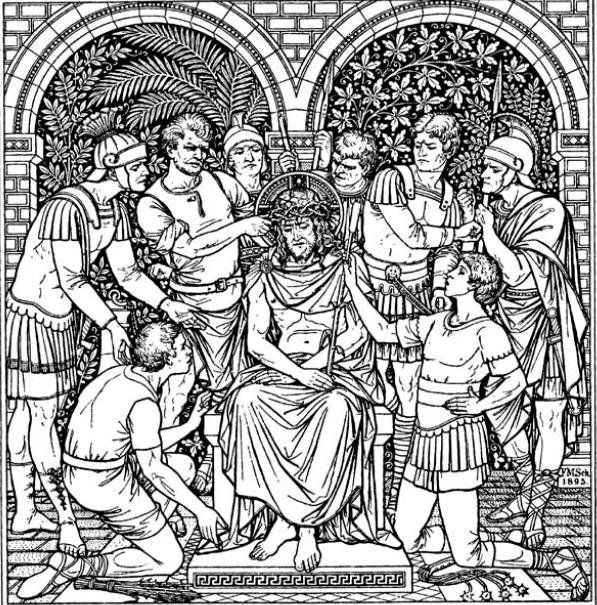
The Roman Catholic church musician is charged with the duty to present sacred texts through music which underscore lessons from Holy Scripture both to instruct the faithful and to re-orient their souls for worship of the Almighty. He also must select appropriate instrumental repertoire which fosters the same. The music of the house of God is not the music of the secular world. We allow ourselves so easily to be duped by modern culture, that in our churches there is a place for secular music and for music which imitates it. Our society teaches us that the sonorities and style of popular music should attract us all the more to worship, even worship within a Catholic liturgical context. This false logic produces a house of God imbued with the secular, a temple much like that which Christ himself cleansed, according to the Gospel of St. Mark 11:15ff. The true music of the house of God is concerned solely with the worship of the Most High and must be suitable to accompany the Latin Rite, whose participation in the one sacrifice of Calvary enables the faithful to partake in a foretaste of the Beatific Vision. The secular idiom inherently falls short here, and by its very nature can only deemphasize the Eucharistic Mystery, interfering with the mystic participation in the timeless and thus shifting the attention of the soul from the Holy Sacrifice to the self and to the emotional euphoria its music brings, both of which the indisputable icons of secularism: the self and self-gratification.
Sacred music has indeed changed and developed through its 2000 year history, however, care must be taken that all music used for liturgical purposes is organically and historically linked to the Church’s 2000 year music tradition, as the Holy Father, Benedict XVI, has stated time and again, and most recently on June 25, 2006: “Genuine renewal in Catholic music cannot be achieved except by following the great traditions of the past, of Gregorian chants and sacred polyphony.” The repertoire of chant and polyphony is vast indeed; so too is the treasury of contemporary compositions which have sprung from this tradition and which are still being composed today in the 21st century. We have wasted much time in experimentation with secular idioms in an attempt to homogenize the secular and the sacred, and that in an age when recordings of monks singing the daily office in Latin reach the “top 10” pop chart list. As Catholics we are called to evangelization, to sanctify the secular, not to secularize the sacred. The Church musician offers to God a sacrifice of music and offers to the faithful words and melodies to take along into their workaday world. Sacred music helps to establish a connection between us, the people of God, and our Creator, not only during Holy Mass, but afterwards and throughout the week. Sacred music brings us back to the house of God, if not only for a moment in the day, as we recall our visit to His house and the heavenly banquet to which He continually invites us. “I had rather be a doorkeeper in the house of my God than dwell in the tents of wickedness” Psalm 84:10.
The Roman Catholic church musician is charged with the duty to present sacred texts through music which underscore lessons from Holy Scripture both to instruct the faithful and to re-orient their souls for worship of the Almighty. He also must select appropriate instrumental repertoire which fosters the same. The music of the house of God is not the music of the secular world. We allow ourselves so easily to be duped by modern culture, that in our churches there is a place for secular music and for music which imitates it. Our society teaches us that the sonorities and style of popular music should attract us all the more to worship, even worship within a Catholic liturgical context. This false logic produces a house of God imbued with the secular, a temple much like that which Christ himself cleansed, according to the Gospel of St. Mark 11:15ff. The true music of the house of God is concerned solely with the worship of the Most High and must be suitable to accompany the Latin Rite, whose participation in the one sacrifice of Calvary enables the faithful to partake in a foretaste of the Beatific Vision. The secular idiom inherently falls short here, and by its very nature can only deemphasize the Eucharistic Mystery, interfering with the mystic participation in the timeless and thus shifting the attention of the soul from the Holy Sacrifice to the self and to the emotional euphoria its music brings, both of which the indisputable icons of secularism: the self and self-gratification.
Sacred music has indeed changed and developed through its 2000 year history, however, care must be taken that all music used for liturgical purposes is organically and historically linked to the Church’s 2000 year music tradition, as the Holy Father, Benedict XVI, has stated time and again, and most recently on June 25, 2006: “Genuine renewal in Catholic music cannot be achieved except by following the great traditions of the past, of Gregorian chants and sacred polyphony.” The repertoire of chant and polyphony is vast indeed; so too is the treasury of contemporary compositions which have sprung from this tradition and which are still being composed today in the 21st century. We have wasted much time in experimentation with secular idioms in an attempt to homogenize the secular and the sacred, and that in an age when recordings of monks singing the daily office in Latin reach the “top 10” pop chart list. As Catholics we are called to evangelization, to sanctify the secular, not to secularize the sacred. The Church musician offers to God a sacrifice of music and offers to the faithful words and melodies to take along into their workaday world. Sacred music helps to establish a connection between us, the people of God, and our Creator, not only during Holy Mass, but afterwards and throughout the week. Sacred music brings us back to the house of God, if not only for a moment in the day, as we recall our visit to His house and the heavenly banquet to which He continually invites us. “I had rather be a doorkeeper in the house of my God than dwell in the tents of wickedness” Psalm 84:10.
Sunday, June 18, 2006
CORPUS CHRISTI at Fatima, Lafayette

Ordinary: Missa VIII
Prelude: Meditation sur "ubi caritas" et "Iesu Dulcis", Jean Langlais
Procession: Let All Mortal Flesh
Entree sur "asperges me", Jean Langlais
Gradual: Psalm du jour (Basilica Psalter)
Sequence: Ecce panis angelorum
Alleluia versicle: caro mea
Offertory: O Lord with Wondrous Mystery
Schmuecke Dich, J.S. Bach (Leipzig)
Communion: Ave Verum, Marcel Dupre
Shepherd of Souls (St. Agnes)
Recessional: Acclamations Carolingiennes, "Christus Vincit", Jean Langlais
Wednesday, April 19, 2006
Candid Camera
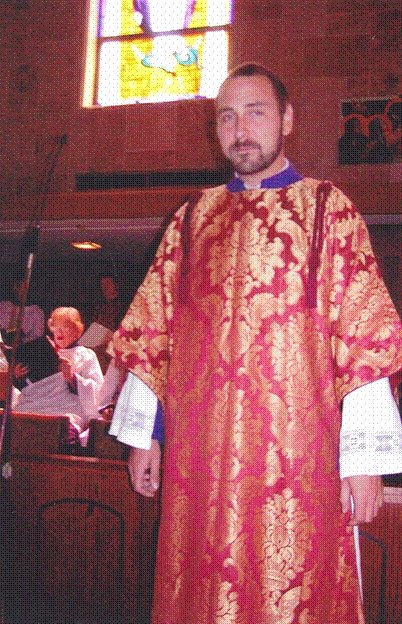
One more photo of the Fatima organist on Good Friday before the commemoration. Here, I'm looking mighty snazzy in my red tunic for the chanting of the Cantor part in the St. John Passion. We removed the tunics after the Gospel, so I didn't have to conduct the polyphony from under that heavy vestment. Far in the background, under the ledge near that square light fixture is Jeremy Coleman, dressed like me -- he sang the Synagogus. We stood at podiums draped in black fabric. The choir and congregation sang the Turba. The alto you see toward the front of the stalls inspecting her music is Maedra Kellmann. She is also an organist, and studied with Helmut Walcha, as did my own organ teacher.
Easter Photos
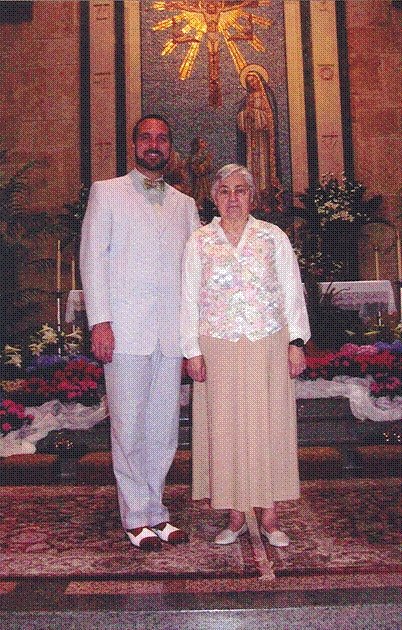
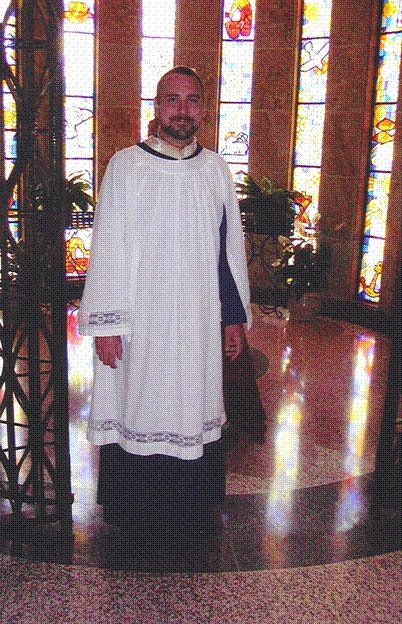 Here are two photos taken in Fatima Church. On the left you see the Fatima Church organist hanging out in the baptistry on Good Friday before the solemn commemoration. On the right, you see the same organist in the sanctuary with his mom on Easter Sunday after low Mass.
Saturday, April 8, 2006
Good Friday at Fatima Church, Lafayette
First Lesson: chanted, solemn tone
Gradual: Psalm 31
Second Lesson: chanted, solemn tone
Tract: Domine, exaudi
Passon according to St. John: chanted, solemn tone
INTERCESSIONS, chanted, recto tono
COLLECTION
Vere Languores Nostros, Lotti
HYMN: O Jesus, King most wonderful (St. Agnes)
INVITATION TO VENERATE
“This is the wood”: chanted.
VENERATION
Popule Meus, Roff, choir
God So Loved the World, Stainer
HYMN: Savior When In Dust to Thee (Spanish Chant)
Chorale: O Darkest Woe, choir
HYMN: Jesus, I My Cross Have Taken (Hyf.)
COMMUNION
At the translation: silence
COMMUNION
Hymn: O Sacred Head Now Wounded
O Bone Iesu, Palestrina
Hymn: Were you There?
Gradual: Psalm 31
Second Lesson: chanted, solemn tone
Tract: Domine, exaudi
Passon according to St. John: chanted, solemn tone
INTERCESSIONS, chanted, recto tono
COLLECTION
Vere Languores Nostros, Lotti
HYMN: O Jesus, King most wonderful (St. Agnes)
INVITATION TO VENERATE
“This is the wood”: chanted.
VENERATION
Popule Meus, Roff, choir
God So Loved the World, Stainer
HYMN: Savior When In Dust to Thee (Spanish Chant)
Chorale: O Darkest Woe, choir
HYMN: Jesus, I My Cross Have Taken (Hyf.)
COMMUNION
At the translation: silence
COMMUNION
Hymn: O Sacred Head Now Wounded
O Bone Iesu, Palestrina
Hymn: Were you There?
Maundy Thursday at Fatima Church, Lafayette
Prelude: O Haupt voll Blut und Wunden, Brahms
Procession: O Living Bread from Heaven (Aurelia)
Kyrie: Missa XVII
Gloria: Missa VIII/Sounding of the organs and bells
LITURGIA VERBI
First Lesson, chanted, solemn tone
Gradual, Psalm 116
Second Lesson, chanted, solemn tone
Tract: Ab ortu solis
Holy Gospel, chanted, solemn tone
Lotio Pedum:The 7 Antiphons
Final antiphon: HYMN: Where Charity and Love Prevail, choir/cong.
Hymn: Lord, Whose Love in Humble Service (In Babylone)
Universal Prayer, chanted, tono recto
Presentation of the holy oils, versicles chanted, tono recto
OFFERTORY
O Salutaris #1, Elgar
Chorale: Soul, Adorn Thyself With Gladness, choir
O Lord I am Not Worthy, (Non sum dignus)
LITURGIA EUCHARISTIAE
Sursum: intoned
Sanctus: Missa VIII
Benedictus: Missa VIII
Mysterium: Christ has died, etc.
Amen: Missa VIII
Pater: tone IV
Agnus: VIII (final petition: miserere nobis, instead of dona nobis pacem!) Ordinary
COMMUNION
Ave Verum Corpus, DesPres, schola
Chorale: Lord, Jesus Christ, Thou Hast Prepared, choir
Christus Factus est, Palestrina
Hymn: O Jesus We Adore Thee, Cong. & choir
Hymn: Humbly We Adore, Cong. & choir
TRANSLATIO
Pange Lingua, choir
Tantum Ergo, Smit, schola
Tantum Ergo, Wasner, schola
Procession: O Living Bread from Heaven (Aurelia)
Kyrie: Missa XVII
Gloria: Missa VIII/Sounding of the organs and bells
LITURGIA VERBI
First Lesson, chanted, solemn tone
Gradual, Psalm 116
Second Lesson, chanted, solemn tone
Tract: Ab ortu solis
Holy Gospel, chanted, solemn tone
Lotio Pedum:The 7 Antiphons
Final antiphon: HYMN: Where Charity and Love Prevail, choir/cong.
Hymn: Lord, Whose Love in Humble Service (In Babylone)
Universal Prayer, chanted, tono recto
Presentation of the holy oils, versicles chanted, tono recto
OFFERTORY
O Salutaris #1, Elgar
Chorale: Soul, Adorn Thyself With Gladness, choir
O Lord I am Not Worthy, (Non sum dignus)
LITURGIA EUCHARISTIAE
Sursum: intoned
Sanctus: Missa VIII
Benedictus: Missa VIII
Mysterium: Christ has died, etc.
Amen: Missa VIII
Pater: tone IV
Agnus: VIII (final petition: miserere nobis, instead of dona nobis pacem!) Ordinary
COMMUNION
Ave Verum Corpus, DesPres, schola
Chorale: Lord, Jesus Christ, Thou Hast Prepared, choir
Christus Factus est, Palestrina
Hymn: O Jesus We Adore Thee, Cong. & choir
Hymn: Humbly We Adore, Cong. & choir
TRANSLATIO
Pange Lingua, choir
Tantum Ergo, Smit, schola
Tantum Ergo, Wasner, schola
Sunday, March 12, 2006
Music for Reminiscere at Fatima Church, Lafayette
Procession: Open Now Thy Gates of Beauty (Neander)
Kyrie: Missa XVII
Tract: Commovisti, Domine
Credo: Credo III
Offertory: O King of Might and Splendor (O Haupt voll Blut)
Sanctus: Iubilate Deo
Mysterium: Danish A
Amen: De Angelis
Agnus: Iubilate Deo
Communion: Jesu, Word of God Incarnate (Ave Verum), Elgar
Gift of Finest Wheat (Eucharistic Congress)
Final: Holy God, We Praise Thy Name (Grosser Gott)
Kyrie: Missa XVII
Tract: Commovisti, Domine
Credo: Credo III
Offertory: O King of Might and Splendor (O Haupt voll Blut)
Sanctus: Iubilate Deo
Mysterium: Danish A
Amen: De Angelis
Agnus: Iubilate Deo
Communion: Jesu, Word of God Incarnate (Ave Verum), Elgar
Gift of Finest Wheat (Eucharistic Congress)
Final: Holy God, We Praise Thy Name (Grosser Gott)
Monday, February 27, 2006
Mozartjubilaeum!
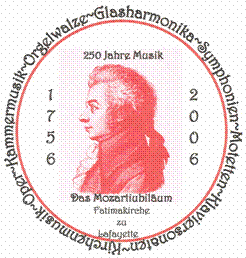
Fatima Church Lafayette adds itself to the list of celebrations around the world of the 250th birthday of W.A. Mozart. Visit the Fatima website to learn more details about the concerts offered throughout the year. All of the concerts will feature works of various composers, but will include at least one item by Mozart. The series starts on March 17 with my organ program:
Wir glauben all' an einen Gott, Samuel Scheidt
Adagio fuer Glasharmonika, W. A. Mozart
Fuge in g moll, W.A. Mozart (realised fragment)
Passacaglia und Thema-Fugatum, J.S. Bach
The Combat of David and Goliath, Joh. Kuhnau
The series runs through the Feast of the Immaculate Conception with choral Vespers in the church.
Music in Lent at Fatima Church, Lafayette
For the first Sunday of Lent, I usually write a blurb for the parish bulletin which explains to the faithful the various minor changes to the liturgy during this holy season. Here is the brief article:
SACRED MUSIC DURING THE HOLY SEASON OF LENT
Faithful Mass-goers will observe a number of traditional modifications to the daily and Sunday liturgies during Lent which reflect the penitential nature of the season. No altar flowers are present during the season, with the exception of the fourth Sunday, Laetare, which offers a slight respite from the rigors of fast, abstinence, penitence, and alms-giving. Also, there are neither organ preludes nor postludes played, or any other instrumental music offered at Holy Mass during the season. Instruments are used solely for the introduction to and accompaniment of singing. In Lent, the faithful will notice during the distribution our practice of singing several communion hymns. The canticle of the angels, the Gloria in Excelsis, common to the Mass after the Kyrie at other times, is omitted throughout Lent. Also, the Alleluia is absent from all hymns and chants, and especially before the versicle preceding the reading of the Holy Gospel. In place of the Alleluia and versicle at the Gospel Procession of Solemn High Mass, the prescribed Lenten Tract is intoned. The Tracts are lengthy scriptural texts appointed by Holy Mother Church especially for use at this point in the Mass on each of the Lenten Sundays. At other Masses and at daily Mass, a simple Lenten acclamation is used. At Solemn High Mass, the ordinary will be the Kyrie Eleison from Missa XVII in conjunction with the chants of the Iubilate Deo. In Holy Week, it is the tradition of the Church that no musical instruments whatsoever be used to accompany singing. We will continue to observe this worthy and pious tradition. For complete listing of the Tracts in Latin with English translation, please visit the Sacred Music page of the parish website: www.fatimalafayette.org.
SACRED MUSIC DURING THE HOLY SEASON OF LENT
Faithful Mass-goers will observe a number of traditional modifications to the daily and Sunday liturgies during Lent which reflect the penitential nature of the season. No altar flowers are present during the season, with the exception of the fourth Sunday, Laetare, which offers a slight respite from the rigors of fast, abstinence, penitence, and alms-giving. Also, there are neither organ preludes nor postludes played, or any other instrumental music offered at Holy Mass during the season. Instruments are used solely for the introduction to and accompaniment of singing. In Lent, the faithful will notice during the distribution our practice of singing several communion hymns. The canticle of the angels, the Gloria in Excelsis, common to the Mass after the Kyrie at other times, is omitted throughout Lent. Also, the Alleluia is absent from all hymns and chants, and especially before the versicle preceding the reading of the Holy Gospel. In place of the Alleluia and versicle at the Gospel Procession of Solemn High Mass, the prescribed Lenten Tract is intoned. The Tracts are lengthy scriptural texts appointed by Holy Mother Church especially for use at this point in the Mass on each of the Lenten Sundays. At other Masses and at daily Mass, a simple Lenten acclamation is used. At Solemn High Mass, the ordinary will be the Kyrie Eleison from Missa XVII in conjunction with the chants of the Iubilate Deo. In Holy Week, it is the tradition of the Church that no musical instruments whatsoever be used to accompany singing. We will continue to observe this worthy and pious tradition. For complete listing of the Tracts in Latin with English translation, please visit the Sacred Music page of the parish website: www.fatimalafayette.org.
Subscribe to:
Posts (Atom)