When's the last time you've heard the words HOLY and MASS put together as a phrase? HOLY MASS! Last time I heard the expression "Holy Mass", it was in reference to the Tridentine Mass, around the time I started at Holy Name of Jesus Church in Providence in June, 1999. Holy Name is the only parish in the diocese of Providence (which covers all of Rhode Island) that has a diocesan-approved Tridentine Latin Mass. And in the promotional pamphlet for the Traditional Mass was a saying that said "Don't pray at Holy Mass, but pray the Holy Mass."
You never hear "Holy Mass" in reference to the Novus Ordo Mass. But why? Is it the Novus Ordo Mass itself that's not so holy? I would think not. A Novus Ordo Mass done right and with reverence would be by all means holy. It was intended for a much higher level of participation by the congregation. But I highly doubt that it was cause for "de-sanctification".
The possibility is that it was the way Mass is often abused. Watered down homilies. Watered down music. Altering of Mass texts. Inclusive language. Removal of sacred language to yield a modern text. All these in attempt to make the Mass "politically correct", just as "politically correct" as being "pro-choice". It's too bad. Vatican II never asked for these abuses. Don't blame Vatican II. Even in the most recent
Institutio Generalis Missalis Romani, chant is still supposed to hold pride of place. The
Constitution of the Sacred Liturgy called for the pipe organ to be "held in high esteem". In the Mass as we know it today, it is asked that the people are readily able to at least sing the simple chants of the Mass in Latin, which is why the Bishops compiled the collection of simple Mass chants known as
Jubilate Deo in 1974.
Instead, job ads in web sites like the
National Association of Pastoral Musicians look for musicians who are profieicent in "organ AND piano", and in most cases, the priority seems to lean toward the piano. A good portion of these parishes hiring will have three or more Masses with music led by a different contemporary group for each Mass and only one with at least the traditional concept of a choir, accompanied by the organ. Most of the hymnals and missalettes pumped out by the major publishers contain about 30-35% traditional music, taking a back seat to the "happy clappy feel good stuff". Where's the "pride of place" in chant? Where's the "high esteem" of the pipe organ? And, yes, I've even heard stories from people saying "oh, Vatican II did away with Latin". Vatican II never abolished Latin. It's still the official language of the Church. Vatican II did, indeed, welcome the Vernacular tongues, with the intent (and hope) of at least some of the Mass (e.g., the Canon) being done in Latin.
Further, Vatican II never demanded, nor asked for the tearing down of altar rails or high altars. They did ask for an altar placed in such a way that the priest would face the people, and that new buildings that are built accomodate accordingly. But they never asked for existing High Altars of Sacrifice to be removed. Prominantly placed in the center of many of these high altars is the Tabernacle, where the Blessed Sacrament is stored.
Mass seems to center on "us" instead of centering on the Real Presence - Jesus Christ in the Blessed Sacrament. That wasn't Vatican II's doing. Look at the majority of the hymns in GIA's Gather Comprehensive and OCP's Music Issue, and you'll find out it was composers, publishers, pushy feminist groups, arrogant liturgist wannabes, etc., that has worked ever so-hard to de-sanctify "Holy Mass". Suddenly the Entrance Hymn - the Introit (from the Latin
Introitus, meaning entry), that is, the Entrance of the priest (who, as my pastor, Fr. Jay Finelli, correctly states, acts in the name of Christ) became the Gathering Song - as in, the Gathering of the people. Think of the "Prayers at the Foot of the Altar" in the 1962 Roman Missal -
Introibo ad altare Dei - I will go to the altar of God, the words of the priest. The Recessional became "Sending Forth". The Offertory became the "Preparation of the Altar and Gifts". The Roman Missal still states that at that time "the Offertory Song is sung". There is no "Preparation Song" as many modern day liturgists like to refer it as. It's as if all mention of offering the gifts (not just the money, but the Bread and Wine to be transformed into the Body and Blood of Christ) is lost.
Here's another spiffy example of the "about us" thing. At the end of Mass in one of my former parishes, while I was well into the postlude, a gentleman approached me and said that I was "playing too loud because the people in back couldn't hear themselves in idle chat". Since when did idle chat hold a prominent place in the House of God???
And, seriously, there is absolutely no need in many cases to have a half dozen or more Extraordinary Ministers of Communion at each and every Sunday Mass. Extraordinary Ministers of Communion (EMC's) were intended for use in Extraordinary circumstances - e.g., one priest having to give Communion to 400 congregants, which may call for one, maybe two EMC's - not because the EMC's themselves are "extraordinary".
At
Holy Ghost Church, we have been in the process of what's known as
Restoration of the Sacred. Fr. Finelli has done a wonderful job in his efforts to restore Mass to its rightful beauty, a beauty that leads many to leave church with the feeling that they actually went to Holy Mass. Music sacred enough for use at Mass has been in full use there now since October 2004. This was a major factor in Fr. Finelli's hiring me as music director. People are singing standard hymns that haven't been sung at Holy Ghost in a long time. In addition, thanks to an anonymous donor, we were able to have a Rodgers organ installed in December 2004, replacing a Kurzweil keyboard. The choir area was moved in August 2004 - from their "stage" near the altar to the former location of the choir room, an area still prominent enough for music ministry to take place in accordance with current liturgical documents. We're not the only parish that is restoring Holy Mass. We're still a rare breed, but many younger priests, like Fr. Finelli (ordained in 1992), are taking the cue in the right direction. I also won't take all the credit for this reform. I thank the pastor, who is righteous in conforming to the liturgy documents, who supports my work as a music director and organist, and the work of many others in their departments.
Another rare breed, a little more than a thousand miles away from me, is
St. John Cantius Church in Chicago, Illinois. St. John Cantius has a little something for everybody who enters - and rest assured, it's Holy Mass. Their weekend schedule consists of two Masses in English, one Latin Novus Ordo, and two Tridentine Masses (one Low, one High).
The Adoremus Society is an excellent resourse to turn to. Its
website gives links to tons of documents, pre- and post-Conciliar. The "liturgo-nazi's" are intimidated by this Society. However, the goal of the Adoremus Society, since its founding in 1995 is to restore the Sacred Liturgy. The Adoremus Bulletin has a lot of great articles. And, guess what - part of my benefit package includes an Adoremus membership - something very worthwhile to real pastoral musicians.
My good Internet friend Jason Pennington put it well on GIA's old message boards, that being "pastoral" is "not giving people what they
want, it's giving people what they
need."
Fr. Anthony Mancini, rector and music director at the Cathedral of SS. Peter and Paul in Providence, once had this to say at a Lenten Mission at one of my former parishes:
"God never answers my prayers!" "God indeed answers your prayers. Just sometimes God says NO!"I implore and challenge all involved in Roman Catholic Liturgy - musicians, liturgists, and even priests - and I even challenge myself - to really be "pastoral" and restore "holy" in "Holy Mass".
Have a Blessed Triduum.
+In Christ,
BMP


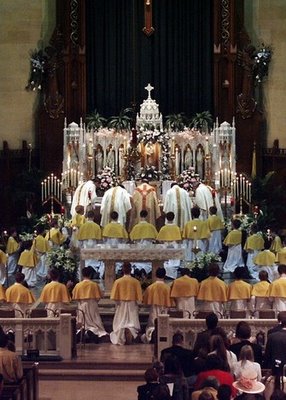 Assumption Grotto, Detroit MI
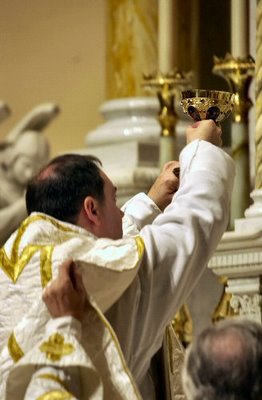 Saint Agnes Church, St. Paul MN
